
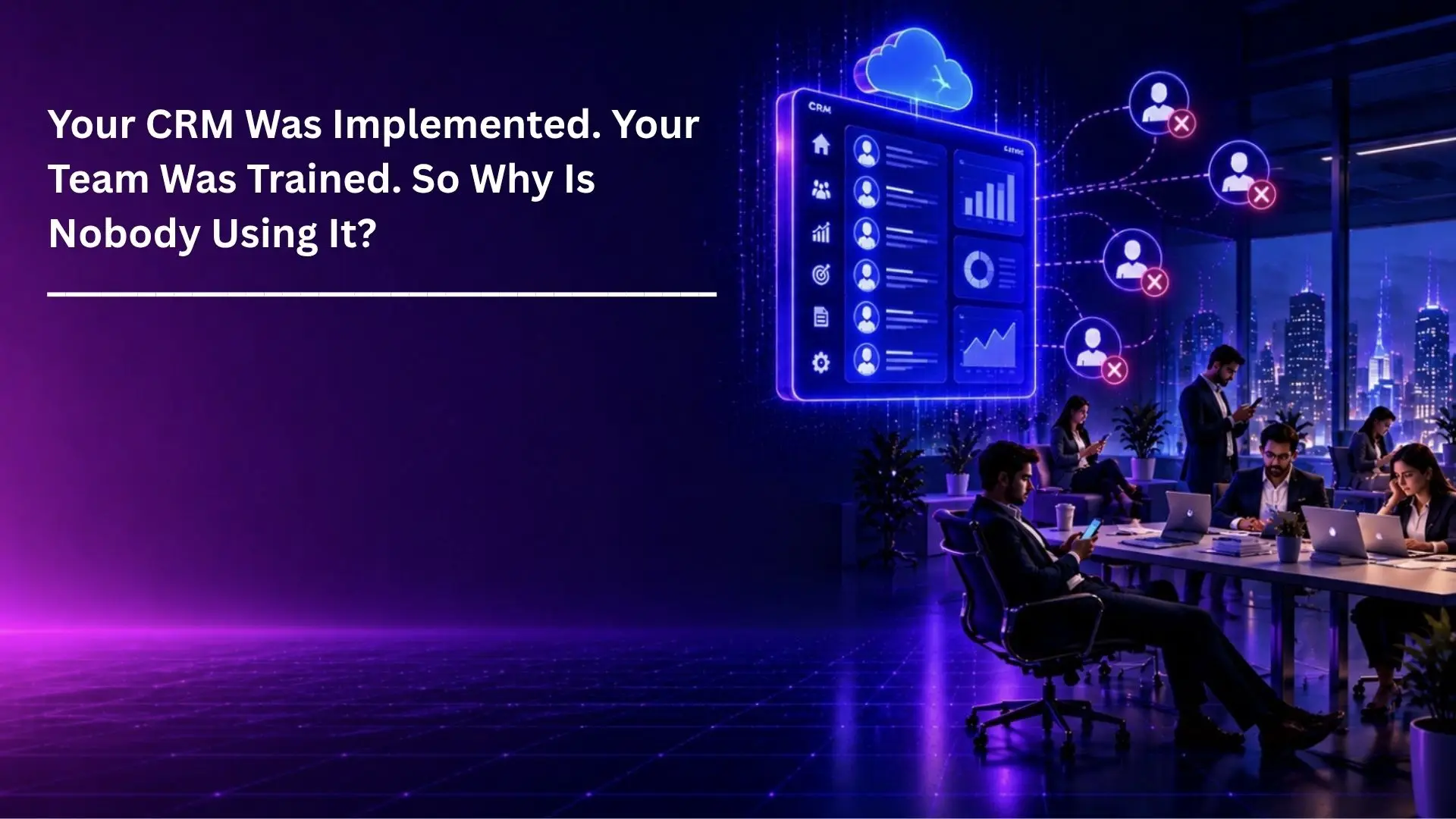
Your CRM Was Implemented. Your Team Was Trained. So Why Is Nobody Using It?
Implementation installs software. Adoption installs a new way of working. If your revenue process did not change, you did not buy a system. You bought a digital witness to the same old habits.
The meeting that exposes the truth
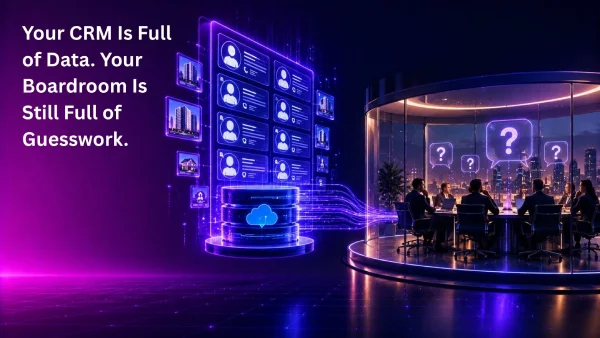
The CRM dashboard is open. The CEO asks a simple question:
“Show me the last ten qualified opportunities that turned into bookings.”
The sales head clicks through pipelines. The marketing head opens campaign reports. The channel partner manager checks a spreadsheet. Someone mentions WhatsApp. Someone else mentions a manual register at the site office.
The CRM shows activity. It does not show the story.
This is the moment when technology reveals its limits. A system can be implemented. Users can be trained. Logins can be recorded. But if the business still operates through spreadsheets, phone calls, and informal promises, the CRM becomes shelfware, expensive, unused, and ultimately abandoned.
ACX Totality is built for precisely this problem. Its product material states the uncomfortable pattern explicitly:
- The software goes live, but nobody redesigns how the team actually works.
- Reports exist. Trust doesn't.
- Users are trained. Habits aren't.
- CRM goes live. Adoption doesn't.
Without a dedicated owner driving accountability, the CRM becomes a database that witnesses the loss.
Why do so many CRM implementations fail to create adoption?
Because they treat adoption as a training event rather than an operating system.
Most CRM projects follow the same arc:
- A vendor demos the platform.
- Leadership approves the purchase.
- A partner configures fields, stages, and workflows.
- Users attend a training session.
- The system goes live.
- Old habits return within weeks.
The technology was installed. The operating system was not.
ACX Totality describes this failure pattern clearly: the CRM market is saturated, most platforms are already implemented, yet outcomes still disappoint, not because of technology, but because adoption never happens. Totality exists to fix what every CRM ignores: turning implementation into real usage.
The difference is not incremental. It is fundamental.
What is the difference between training and adoption?
Training teaches people how to use a tool. Adoption ensures the tool changes how the business works.
Training is a session. Adoption is a management system.
Training explains where to click. Adoption ensures the click matters.
ACX Totality's Adoption Framework is designed to operationalise this distinction. It follows six structured phases:
- Configure: Align the system to your actual sales journey.
- Train: Teach users the workflows, not just the screens.
- Monitor: Track usage, data quality, and stage movement.
- Enforce: Make the system use a non-negotiable part of the process.
- Improve: Refine workflows based on live performance data.
- Institutionalise: Embed the system into daily behaviour until it becomes permanent infrastructure.
This is how a CRM stops being a reporting burden and starts being a sales tool.
Why do users abandon a CRM even after training?
Because the system often asks them to do more work without giving them more value.
A sales executive is asked to:
- Log every call.
- Update every stage.
- Fill every field.
- Upload every document.
But in return, they receive:
- Generic follow up lists.
- No clarity on which leads are truly hot.
- No help with objections.
- No visibility into what happens after they hand off a lead.
- No feedback on which behaviours create bookings.
From their perspective, the CRM is a compliance tool, not a performance tool.
ACX Totality is engineered around adoption with dedicated operators, structured protocols, and accountability frameworks that ensure the system gets used, not just installed. Success is measured not by logins but by business outcomes: response rates, conversion ratios, attribution accuracy, and sales velocity.
That is the standard CEOs should demand.
A system should not be considered successful because it is installed. It should be considered successful because the business behaves differently and revenue becomes more predictable.
What role does the Forward Deployed Operator play?
Most CRM companies provide software. Totality provides deployment ownership.
Every Totality Command engagement includes a Forward Deployed Operator (FDO), an embedded partner responsible for making the sales system actually work. The FDO helps with:
- Process mapping across the entire sales journey.
- Workflow design to reduce friction and manual effort.
- Adoption management to ensure consistent and correct usage.
- Attribution validation so revenue credit is assigned accurately.
- Leadership reviews to connect system performance to business outcomes.
- Optimisation roadmaps based on live performance data.
The FDO's mission is direct:
Find the link. Fix the link. Scale the system.
This matters because technology alone does not scale businesses. Systems do. And systems only work when adoption, accountability, and continuous optimisation are built in.
Why do reports exist but trust does not?
Because dashboards often reflect activity, not outcomes.
A CRM can show:
- Number of leads created.
- Number of calls logged.
- Number of site visits recorded.
- Number of proposals sent.
- Number of bookings closed.
But leadership cannot answer:
- Which channel produced the highest quality leads?
- At which stage did the lost deals drop off?
- Which agent behaviour drives the highest conversion?
- What is the true cost per acquisition by project?
- Can we replicate our best performing sales motion?
When dashboards show conflicting numbers, leadership stops relying on the system entirely. Managers return to spreadsheets. Sales teams treat the CRM as a reporting burden rather than a sales tool. The boardroom reverts to opinion.
This is why Totality emphasises that reports may exist, but trust does not, unless adoption and accountability are enforced.
A system that is not trusted is not a system. It is a digital alibi.
What does adoption look like in a high performing sales team?
It looks like behaviour change, not just screen time.
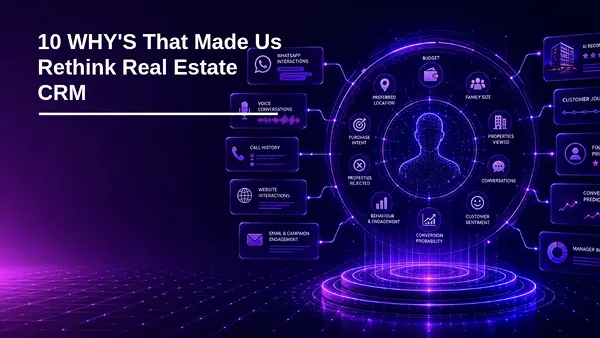
- Leads are captured across channels in a unified pipeline, not scattered across portals, emails, and WhatsApp.
- Contact attempts are logged with outcomes, not just “called” checkboxes.
- Conversations reveal budget, timeline, family decision makers, and concerns, not just “interested” labels.
- Site visits trigger structured follow up protocols with ownership and next actions.
- Proposals are linked to buyer requirements, not generic templates.
- Bookings update inventory, documentation, and attribution in real time.
- Channel partners see verified credit through a transparent system.
ACX Totality's platform modules are designed to support this behaviour:
- Lead Management across digital, referral, walk in, and partner channels.
- Channel Partner (CP) Management for referrals, attribution, and commission workflows.
- An Attribution Engine to assign revenue credit accurately.
- Customer Journey Tracking from first inquiry to final booking.
- A real estate native CRM built around the 7 Links.
- Workflow Automation for follow ups, tasks, approvals, and escalations.
- Reporting and Dashboards for response rates, contact ratios, visit conversion, proposal rates, booking conversion, and cost per acquisition.
- Mobile Applications for agents and managers in the field.
The objective is not to produce more reports. It is to make the revenue story readable, attributable, and actionable.
Why is “adoption determines ROI” a law, not a slogan?
Because the most sophisticated technology delivers zero return if your team does not use it.
This is one of the four laws of Totality:
- Every sale has 7 links.
- The weakest link determines revenue.
- What you can attribute, you can repeat.
- Adoption determines ROI.
These laws shift the conversation from “How many leads?” to “Which link is limiting us?” and from “Who claims credit?” to “What can we prove drove the booking?”
A developer can have excellent lead generation, but if contact is poor, the revenue outcome collapses. Strong contact cannot compensate for weak qualification. Good qualification cannot compensate for missed site visit follow up. A great site visit cannot compensate for a proposal that ignores the buyer's requirements.
The overall result is constrained by the weakest stage.
That is why adoption is not optional. It is the bridge between technology and truth.
What would a leadership review focused on adoption look like?
Instead of asking each department to explain its slice, leadership would review the entire chain.
For every project, the dashboard would show:
- Are teams capturing leads consistently? Lead source completeness and duplication rates.
- Are contacts being attempted and logged? Contact ratios and response times.
- Are conversations being qualified? Budget, timeline, and decision maker fields populated.
- Are visits followed up within 24 to 48 hours? Visit to follow up time and compliance.
- Are proposals linked to buyer needs? Proposal quality and response tracking.
- Are bookings updating inventory and attribution? Real time unit status and verified credit.
- Is the system being used daily? Active users, data freshness, and workflow compliance.
The conversation changes from defence to diagnosis.
Marketing is not asked to justify spend in general terms. It is asked to explain why one channel's leads convert better than another's.
Sales is not asked to explain why bookings are low. It is asked to explain why the visit to proposal ratio collapsed in a specific project.
Channel partners are not asked to trust informal credit. They are shown verified attribution.
This is the difference between a database that stores activity and a system that exposes the commercial logic of the business.
How does Totality turn implementation into adoption?
Through two proprietary protocols: one for client engagement and one for system deployment.
Totality Client Protocol:
- Find: Identify the weakest link in your current sales chain.
- Map: Document the complete sales journey across projects, teams, and channels.
- Connect: Integrate systems, data, and workflows around the 7 Links.
- Adopt: Drive accountability and usage through structured onboarding and reinforcement.
- Scale: Continuously improve performance by identifying bottlenecks and optimising workflows.
Totality Deployment Protocol:
- Audit: Understand current reality: tools, processes, team structure, and data quality.
- Architect: Design future state workflows aligned to the 7 Links and business objectives.
- Activate: Deploy and integrate the Totality Platform with your existing stack.
- Adopt: Train teams, operationalise workflows, and establish accountability structures.
- Analyse: Track performance across all 7 Links with real time dashboards.
- Optimise: Fix bottlenecks, refine processes, and improve conversion.
- Scale: Expand successful patterns across projects and geographies.
This is how a developer stops guessing and starts diagnosing.
What should a CEO ask before buying another CRM?
Ask these questions:
- Will someone own adoption, not just implementation?
- Can this system show me all seven links for every deal?
- Can it identify where lost opportunities dropped out?
- Can it prove which channel and agent influenced each booking?
- Can it measure the time between lead, contact, conversation, visit, proposal, and booking?
- Can it enforce consistent stage definitions across projects?
- Can it show me adoption, not just logins?
- Can it help me replicate my best sales motion?
If the answer to several questions is no, you may be buying another database.
ACX Totality is built for developers who want predictable growth rather than fragmented systems, guesswork, and missed revenue. It positions itself as the operating layer that connects people, processes, technology touchpoints, outcomes, and accountability.
Closing thought: the system your team uses is the system that wins
Your CRM may be implemented. Your team may be trained.
But if nobody is using it, you do not have a sales system. You have a digital witness to the same old habits.
ACX Totality is designed for developers who refuse to leave revenue unpredictable. Its promise is direct:
Find the link. Fix the link. Scale the system.
The developers who win the next decade will not necessarily have the most features. They will have the most adopted, accountable, and outcome focused sales infrastructure.
And when leadership asks, “Is the team using the system?”
The answer will not be, “They log in sometimes.” It will be, “They cannot sell without it.”