
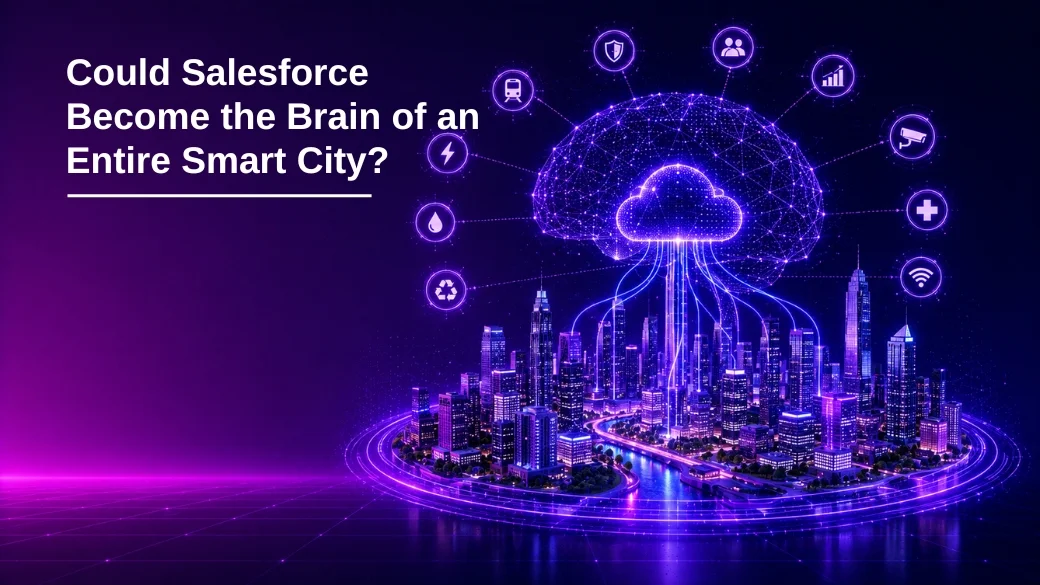
Could Salesforce Become the Brain of an Entire Smart City?
A smart city does not become intelligent because it has more sensors; it becomes intelligent when every signal, from the first inquiry to the resident's daily experience, can be connected, understood, and converted into action.
A city is more than buildings
Picture a new urban development ten years from now.
A resident wakes up to a personalized update about water consumption, community events, transport conditions, and maintenance work. A family enquiring about a home receives recommendations based on lifestyle, budget, commute, and preferred amenities. A channel partner checks live inventory without calling the sales office. A resident raises a service request through a digital portal and receives a response that already understands their unit, payment history, previous conversations, and the exact issue.
The city appears to be operating by itself.
But intelligence is not magic. It comes from connected information, clear ownership, real time workflows, and systems that understand context.
This is where Salesforce enters the smart city conversation.
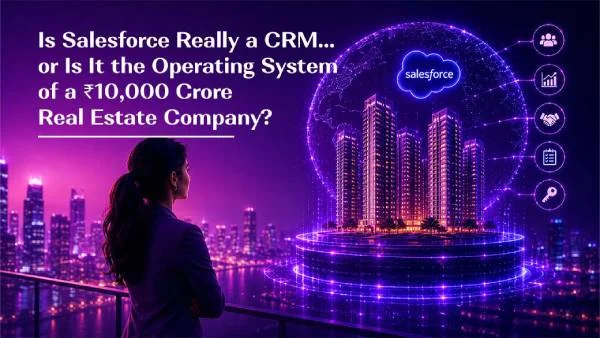
Salesforce is commonly introduced as a CRM. That description is technically correct and strategically insufficient. For a real estate developer, Salesforce can become the relationship and intelligence layer connecting projects, units, buyers, channel partners, marketing, construction communication, service operations, data, analytics, and AI.
The question is not whether Salesforce can manage a city's buildings.
The question is whether it can help a city understand the people who live, work, invest, transact, and interact inside it.
What would a “brain” actually do?
A brain does not merely store facts. It connects signals, recognises patterns, remembers context, prioritises decisions, and coordinates action.
A smart city Salesforce architecture would do something similar.
It could connect:
- Project and tower information.
- Unit level inventory and availability.
- Buyer and resident identities.
- Marketing and campaign engagement.
- Site visits and sales interactions.
- Payment and documentation milestones.
- Construction progress.
- Service cases and maintenance queries.
- Channel partner activity.
- Community and amenity engagement.
- Future purchase and referral signals.
The value would not come from placing every piece of data in one giant database. It would come from giving every authorised team the right context at the right moment.
A sales executive would see more than a lead.
A resident service team would see more than a complaint.
A CEO would see more than bookings.
The entire organisation would see the living relationship between people, properties, services, and outcomes.
Why does real estate need a city scale system?
Because a large development is already a city in commercial terms.
It has:
- Multiple projects and phases.
- Towers, floors, units, amenities, and services.
- Residents, prospects, investors, families, and visitors.
- Developers, contractors, brokers, banks, and service providers.
- Long customer journeys that continue for years.
- Thousands of physical and digital interactions.
- Multiple operational systems that rarely agree perfectly.
The Salesforce book describes a real estate developer as four businesses operating simultaneously: the marketing machine, the sales machine, the construction and delivery machine, and the channel partner machine.
A smart city ambition makes those four businesses even more interconnected.
The same person may begin as a digital lead, become a site visitor, book a unit, receive construction updates, raise service requests, join a resident community, refer a friend, and later purchase another property.
If those stages remain isolated, the city has information but no memory.
Salesforce can provide the memory.
Can one customer identity connect the entire city?
That is the foundation.
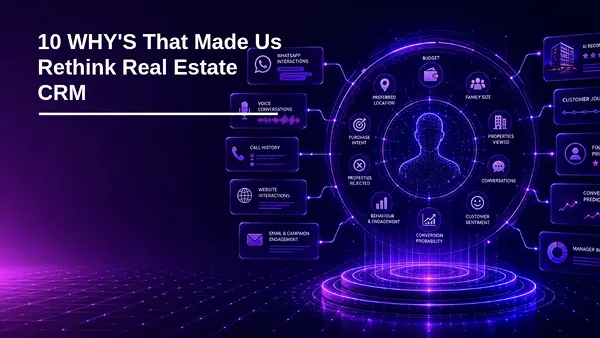
A resident may appear in the website database, Sales Cloud, Marketing Cloud, ERP, payment system, service desk, WhatsApp records, and community application. If those systems cannot recognise that they refer to the same person, every interaction begins from zero.
The customer has to repeat their name, unit number, concern, and history.
That is not smart. It is exhausting.
Salesforce Data Cloud is designed to unify identities across systems and create a more complete customer profile. In the real estate context, the book identifies the need to connect website, CRM, marketing, payment, construction, ERP, WhatsApp, and other sources into a unified identity.
Imagine the possibilities:
- A resident's service request is linked to their exact unit.
- The service team can see relevant payment and document status.
- Communication is sent through the resident's preferred channel.
- The system knows whether the issue is new or recurring.
- A future project recommendation reflects actual interests.
- A referral from that resident retains its complete source history.
The city becomes more responsive because it recognises people as whole relationships, not disconnected records.
What does the city's inventory brain look like?
Smart city intelligence must begin at the unit level.
A generic product catalogue cannot represent the complexity of real estate. A project may contain hundreds of unique units, each with a different tower, floor, orientation, area, parking arrangement, price, possession timeline, and availability status.
The book describes the unit as the most important custom object in a real estate data model. Each unit must reflect its attributes and real time status: available, held, booked, registered, or possession given.
This creates an inventory truth engine.
A buyer searching for a high floor apartment with an open view should not receive a generic brochure. They should receive relevant available options. A broker should not need to call five people to confirm whether a unit is still open. A sales executive should not promise an apartment that was booked earlier in the day. A leadership dashboard should not show three different inventory numbers depending on which spreadsheet was opened.
In a smart city, inventory is not a static list.
It is a live, shared, governed system.
How would a smart city sell homes differently?
The sales process would become context aware.
A buyer may discover the development through an advertisement, explore a project page, watch a video, speak to a broker, attend a site visit, and then disappear for two weeks while discussing the purchase with family.
A conventional funnel records fragments.
Salesforce can connect the journey and identify the next best action.
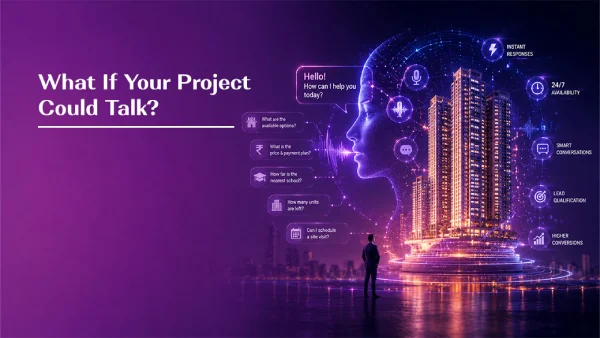
Einstein can help score propensity based on historical behaviour. Marketing Cloud can place the buyer into an appropriate journey. An AI agent can answer initial questions, capture budget and preferences, check live inventory, schedule site visits, and route the lead to the right human executive. Agentforce can operate inside Salesforce with defined data access, permitted actions, and escalation rules.
On launch day, this matters enormously.
A project may generate hundreds of leads within hours. Without automation, high intent buyers wait while teams sort, assign, call, and update records manually. With a connected architecture, each lead can be acknowledged, qualified, prioritised, and routed while the sales team focuses on the conversations that require judgement and trust.
The city's commercial system begins to behave less like a queue and more like a nervous system.
Does the brain continue working after the booking?
It must.
A city that stops listening after the booking is not intelligent. It is merely efficient at acquisition.
The post booking journey may last two to five years. During that period, buyers care about construction progress, payment milestones, documents, possession, changes, delays, quality, and responsiveness. Their experience determines whether they become advocates or detractors.
The Salesforce book states that the construction period is one of the most important phases for referrals, yet it receives the least attention in many implementations. It also emphasises that buyer experience during construction can shape advocacy and repeat purchase.
Service Cloud can manage this phase through:
- Structured cases.
- Ownership and escalation.
- Priority and service level rules.
- Knowledge articles.
- Personalised responses.
- Complete interaction history.
- Self service through a buyer portal.
Experience Cloud can provide residents with access to payment information, receipts, legal documents, construction updates, service requests, and possession documentation.
This is not only operational convenience.
It is urban trust infrastructure.
A resident who receives a clear answer quickly feels that the city is being managed. A resident who has to chase the developer across WhatsApp, phone calls, and email feels invisible.
Could the city learn from every service request?
Yes, and this is where service data becomes hidden gold.
One maintenance complaint may be an isolated issue. Hundreds of similar complaints may reveal a design, communication, vendor, or construction problem.
If service cases are structured and connected, leadership can identify patterns:
- Which towers generate the most queries?
- Which amenities produce repeated complaints?
- Which questions should be answered proactively?
- Which delays are damaging resident confidence?
- Which contractors create recurring issues?
- Which communities are most satisfied?
- Which service experiences produce referrals?
The service desk becomes an urban sensor.
Every query contributes to a more accurate understanding of the city.
This is the difference between resolving tickets and learning from residents.
What role do channel partners play in a smart city?
A smart city cannot depend on informal information networks.
Real estate channel partners are essential participants in the ecosystem, but their operations are often managed through spreadsheets, WhatsApp groups, phone calls, and fragmented commission records. The book identifies channel management as one of the most data leaky parts of the developer's business.
An Experience Cloud partner portal can allow brokers to:
- Register leads.
- Check live inventory.
- Access approved project collateral.
- Track lead status.
- View commission statements.
- Reduce duplicate registration disputes.
- Understand project updates.
The benefit is mutual.
Partners receive speed and transparency. Developers receive structured data, stronger attribution, and better visibility into performance.
In a city scale system, every authorised participant should have a digital front door. The partner portal becomes one such door.
Can Salesforce connect physical and digital city experiences?
That is the ultimate ambition.
A smart city is not only an app. It is a physical environment filled with interactions: entrance gates, experience centres, sample apartments, amenities, service desks, construction sites, parking areas, and community spaces.
The book explores how voice and site visit intelligence can convert previously invisible behaviour into structured data. With appropriate consent, recorded calls can reveal budgets, concerns, commitments, and objections. Site visit systems can help understand engagement with different spaces and features.
This creates a bridge between physical experience and digital intelligence.
For example:
- A buyer shows strong interest in a rooftop amenity.
- The sales executive receives a relevant follow up prompt.
- The buyer receives a personalised communication about that feature.
- Aggregated data shows that the amenity consistently influences decisions.
- Future projects give greater design attention to similar features.
The city begins learning from how people move through it, what they notice, and what they value.
That is not surveillance. It must never become surveillance. Consent, transparency, privacy, data minimisation, and appropriate governance are essential architectural requirements, particularly for voice and camera based capabilities.
What would the CEO see every morning?
A connected executive command centre could show:
- Bookings by project, tower, unit type, and channel.
- Real time inventory and held units.
- Marketing cost against site visits and bookings.
- Lead quality and conversion by source.
- Channel partner contribution.
- Construction communication engagement.
- Service volume, resolution time, and escalations.
- Buyer sentiment and advocacy.
- Cancellation risk.
- Referral and repeat purchase potential.
- AI generated priorities requiring leadership attention.
Tableau can provide sophisticated visualisation across Salesforce and connected data sources, but the book offers a crucial warning: beautiful dashboards built on dirty data produce confident looking misinformation.
The CEO does not need more charts.
The CEO needs a reliable view of reality.
What happens when AI becomes the city's operating layer?
AI can help the city move from reporting to anticipation.
Instead of waiting for a buyer to complain, the system may identify a pattern of disengagement. Instead of discovering at the Monday meeting that a high propensity buyer has stalled, the system can alert the manager after a defined period without follow up. Instead of asking a resident to search for a document, an AI service agent can retrieve the relevant information within permitted boundaries.
The book distinguishes between predictive intelligence and autonomous action. Einstein can score and recommend; Agentforce can engage, qualify, route, answer, and perform approved actions.
But the sequence matters:
- Establish a clean data model.
- Connect systems through reliable integrations.
- Standardise stages, statuses, and definitions.
- Define permissions and governance.
- Instrument outcomes.
- Introduce AI agents gradually.
- Measure business impact, not novelty.
An AI agent reading inaccurate data is not intelligence. It is accelerating confusion.
What prevents a smart city Salesforce from failing?
The biggest danger is building a technology showcase instead of an operating system.
The book identifies six recurring failures in real estate implementations: flawed partner selection, lack of domain expertise, overcustomisation, an unmapped customer journey, attribution chaos, and weak last mile execution.
Each one can damage a smart city vision:
- A generic partner may not understand inventory or resident lifecycles.
- Overcustomisation may make the architecture too fragile to evolve.
- An unmapped journey may end at booking.
- Broken attribution may hide the value of referrals and partners.
- Weak governance may create conflicting versions of the truth.
- Poor last mile execution may leave high value opportunities untouched.
The solution is not to buy more software.
It is to begin with the city's operating reality.
Map the journey. Define the objects. Standardise the language. Clarify ownership. Build only what creates measurable value. Use configuration before customisation. Treat go live as the beginning of adoption, not the end of implementation.
Will developers become the new urban systems architects?
Yes, and the best developers will have an advantage.
Developers who understand only individual features may build screens. Developers who understand data architecture, APIs, event flows, permission models, packaging, observability, AI guardrails, and real estate processes can build systems that compound in value.
They will design:
- Real time inventory services.
- Buyer and resident identity models.
- Partner portals.
- Agent actions and permissions.
- Construction communication workflows.
- Service intelligence.
- Attribution frameworks.
- Data products for future projects.
- Reusable industry packages.
This is the FOMO hidden inside the smart city idea.
The race is not to configure another CRM.
It is to build the intelligence infrastructure that competitors will struggle to recreate once your organisation has accumulated years of connected data.
So, could Salesforce become the brain of an entire smart city?
Salesforce would not replace every system in a city. It should not attempt to.
An ERP may manage finance. Construction platforms may manage delivery. IoT systems may manage physical infrastructure. Payment platforms may process transactions. Mobility, security, utilities, and civic systems may each have specialised technology.
The role of Salesforce is to connect the human and commercial relationships across these systems, to provide a trusted customer and resident context, coordinate action, surface intelligence, and help every team understand what should happen next.
It can become the city's relationship brain.
Not because it knows everything, but because it can make the right information available to the right person, at the right time, with the right next action.
Closing thought: the city that remembers
A building is concrete.
A city is coordinated.
It is the memory of who lives where, what they need, what they were promised, what has been delivered, and how every interaction changes their trust in the ecosystem around them.
The smartest city will not necessarily have the most sensors, the most apps, or the most futuristic architecture.
It will be the city that remembers.
It will remember the buyer who asked about possession. The resident whose service request is still unresolved. The channel partner who consistently brings quality demand. The amenity that influences bookings. The communication that restores confidence. The signal that indicates a future purchase.
Salesforce can become the connective intelligence behind that memory.
And when a city can remember every relationship, learn from every interaction, and act before problems become visible, it stops being merely smart infrastructure.
It becomes a living commercial ecosystem.
The developers who build that ecosystem first will not simply sell more homes.
They will own the operating intelligence of the places people choose to live.