
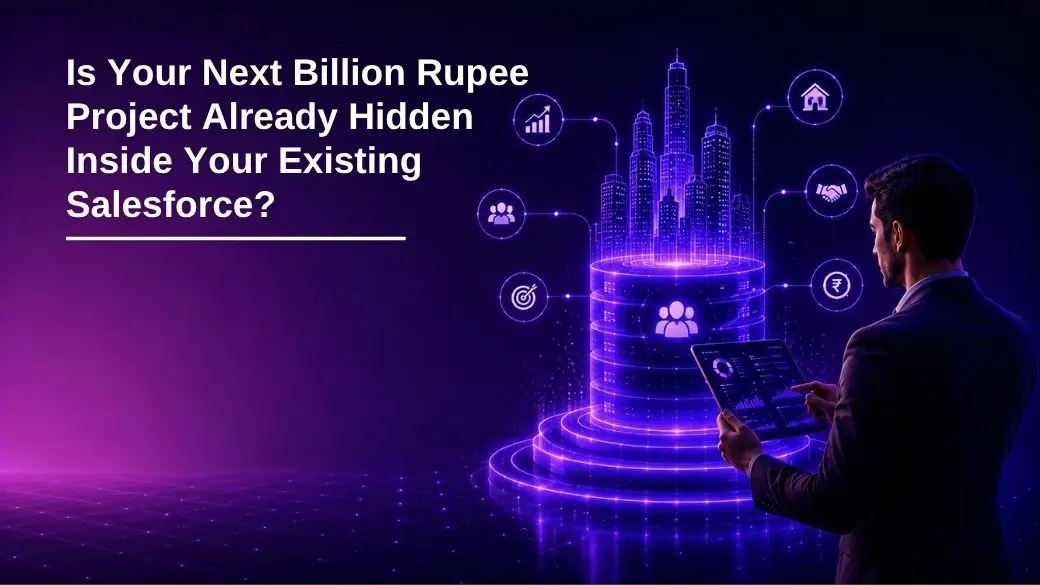
Is Your Next Billion Rupee Project Already Hidden Inside Your Existing Salesforce?
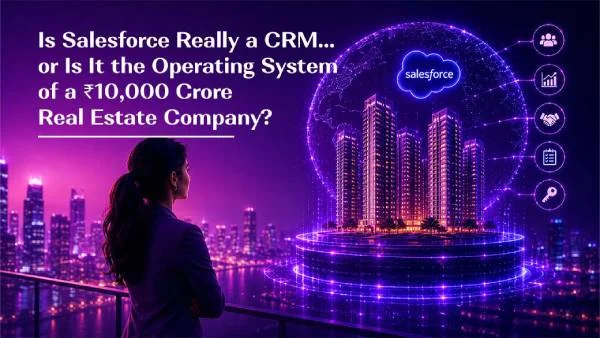
Your Salesforce isn't just a CRM, it's a fully instrumented digital city where the signals of your next billion rupee product are already flowing; you just need to mine them.
What Do You Mean by 'Your Next Billion Rupee Project Is Already Hidden Inside Your Existing Salesforce'?
Imagine a city that's already built: streets, power, data pipelines, a skilled workforce, but the city council treats it like a storage yard. Salesforce isn't just a CRM; it's a fully instrumented digital city where customer interactions, automation, integrations, analytics, and AI telemetry quietly accumulate value every day.
The 'billion rupee' project isn't a new product idea that needs to be built from scratch. It's an opportunity to recompose, rewire, and monetize the data and processes already living in your org, faster, cheaper, and with far less risk than greenfield development.
Why Does This Idea Feel So Urgent for CEOs Right Now?
Because time compounds. Competitors who mine their Salesforce for productization, new revenue streams, and efficiency gains capture market share and margins while others keep commissioning new HR projects and custom apps that don't scale.
If your Salesforce holds clean signals (customer journeys, usage patterns, high value accounts, churn predictors), you can convert those signals into premium services, business intelligence products, and automated upsell engines, and launch them in months, not years.
The ROI math is brutal: lower acquisition cost (you already own the touchpoints), faster time to market, and immediate revenue capture. CEOs who don't act watch opportunity bleed to those who do.
How Can Developers Spot 'Hidden' Billion Rupee Opportunities Inside Salesforce?
Look for high signal places where behavior meets pain:
- Repeated manual workflows that slow revenue teams (quote generation, custom approvals, manual reconciliation).
- Cross sell or renewal paths with low automation and high friction.
- Data islands: objects or integrations that are rich in real world signals but not analyzed.
- Feature requests that come up repeatedly from top customers are product cues.
- Usage telemetry from managed packages or Service Cloud cases showing patterns that predict churn or expansion.
If you can draw a straight line from a pain (or signal) to a monetizable outcome (premium feature, automation service, analytics product), you've found a candidate.
Give Me Three Concrete Billion Rupee Product Ideas You Can Build Out of Salesforce in Weeks, Not Years
Automated Renewal & Expansion Engine. A configurable, AI driven pipeline inside Salesforce that detects expansion signals (usage, product adoption score, account sentiment from cases/emails), surfaces prioritized playbooks, generates smart quotes, and triggers automated multichannel outreach. Why it's a winner: reduces churn, increases wallet share, ties directly to revenue operations. Implementation: combine Sales Cloud, Einstein/LLMs for signals, CPQ for quotes, Flow for automation. Monetization: packaged as an add on managed service or subscription.
Data Product: 'Customer Health Index' API. Turn your CRM signals into a time series health index per account, exposing an API that product, finance, and partner teams (or paying customers) can use to forecast revenue and risk. Why it's a winner: every customer facing team and investor wants forward looking clarity. Implementation: compute indices via Apex or external compute (Heroku/FaaS), store snapshots in custom objects or Data Cloud, deliver via API and dashboards. Monetization: sell as internal premium reporting, or as a licensed data feed to channel partners.
Verticalized Automation Packs. Create industry specific automation templates (insurance claims triage, B2B subscription onboarding, retail return authorization) built on Flow, OmniStudio, and integrations. Why it's a winner: companies hate one off implementations. Turn repeatability into a product: license the pack, provide rapid deployment services, and charge for ongoing updates. Implementation: distill best practices into templates, package metadata, provide deployment scripts. Monetization: license + implementation + updates.
Aren't These Just Internal Improvements? How Do We Actually Capture Cash From Them?
Good question, monetization is strategic, not accidental. Options:
- Internal chargeback: Treat the product as a profit center and sell to internal business units at market price. This shows ROI and primes a later external launch.
- Externalize: Package the capability as a managed service or AppExchange product. Use your own customers as early adopters.
- Embedded monetization: Use automation to increase attach rates and higher ARPU for existing products, the revenue lift funds further development.
- Data licensing: Anonymize and aggregate telemetry into insight feeds for partners or vendors.
- Professional services: Sell fast deployments and customizations as a premium service offering.
Developers Might Think 'Salesforce Is Limiting, We're Boxed In.' Is That True?
That's a myth. Salesforce's platform is one of the richest options for building scalable, secure, enterprise grade products quickly. Yes, there are governor limits and platform constraints, but those are guardrails that force good architecture. The modern Salesforce stack includes:
- Declarative building blocks (Flow, OmniStudio) for speed.
- Apex and platform events for complex logic and integrations.
- Data Cloud and Salesforce Functions for large scale compute and analytics.
- APIs, MuleSoft, and named credentials for secure integrations.
- Einstein/LLMs and prompt orchestration for enriched customer interactions.
Combine them and you get rapid iteration, strong compliance posture, and built in distribution (AppExchange, partner ecosystem). The trick is to design products as composable services: small, testable, instrumented.
How Do You Structure an Experiment to Validate a Billion Rupee Idea Inside Salesforce Without Wasting Months?
Run a sprinted discovery and build plan in three waves (6-10 weeks total):
- Wave 0, Signal audit (1 week): Map sources: objects, integrations, flows, cases, CPQ, telemetry. Estimate data quality and gaps. Pick one metric that correlates with value (e.g., days to renewal, upsell rate).
- Wave 1, Minimum Viable Product (3-4 weeks): Build a thin end to end loop: signal detection → playbook → automation → measurable outcome. Use Flow for orchestration, a lightweight API for any heavy computation, and a dashboard for the metric. Deploy to a pilot segment (best customers or one geography).
- Wave 2, Business Validation (2-5 weeks): Run pilot, measure lift vs control, capture feedback, and quantify incremental revenue. Price the offering internally or with a small set of external customers. If ROI exceeds threshold, productize: package metadata, add docs, and create a go to market plan.
This structure reduces risk and forces a revenue lens from day one.
What Common Mistakes Kill These Projects Before They Start?
The top killers:
- Building for 'all customers' instead of a specific persona or segment.
- Ignoring instrumented measurement, if you can't measure lift, you can't sell it.
- Over engineering the first version; shipping a raw, measurable capability beats perfect architecture.
- Treating Salesforce as an implementation playground rather than a product platform with design for scale, updates, and security.
- Not involving commercial teams, early product market fit needs sales, CS, and finance buy in.
As a CEO With a Tech Background, How Should I Align Teams and Incentives to Move Fast?
Align around three north stars: value, speed, and measurement.
- Value: require a clear revenue or cost savings hypothesis with unit economics.
- Speed: fund a 6-10 week runway with small cross functional 'product squads' (1 PM/owner, 1 senior developer, 1 analytics lead, 1 sales pilot owner).
- Measurement: define success metrics upfront (lift in conversion, reduction in cycle time, ARR uplift) and instrument them.
- Incentives: tie part of QBR goals and compensation to quick launch metrics for squads. Reward reuse and packaging: teams that turn one pilot into a reusable asset earn higher allocation for future projects.
What Are Developer Level Steps to Make a Prototype Irresistible to the Rest of the Company?
Focus on clarity, speed, and polish where it counts:
- Build the thin end to end: signal → action → measurable outcome. Ship a working loop.
- Make it visible: dashboards, automated reports, and a case study that shows delta vs baseline.
- Automate demos: scripts that show the product running on live or realistic data in minutes.
- Provide a one click pilot install (change sets, unlocked packages, or SFDX scripts) and a rollback plan.
- Add safety: permissions, data masking for demos, and audit trails to answer security questions quickly.
How Do You Price and Package an Internal Salesforce Based Product?
Price like an external SaaS product:
- Estimate value per account or per seat (e.g., reduction in churn = X rupees per account).
- Choose pricing model: per seat, per account, per API call, or revenue share. For internal offerings, chargeback at market equivalent rates.
- Offer tiered packaging: Starter (automation + dashboards), Pro (AI signals + CPQ integration), Enterprise (SLA + custom connectors).
- Add professional services for customization and quarterly updates as a separate revenue stream.
What Role Does AI/LLM Play and How Do You Protect Against Risks?
AI is an accelerant, not a silver bullet. Use LLMs for signal enrichment (extracting intent from case text), playbook generation, and smart quoting. But guardrails are essential:
- Use prompt engineering and retrieval augmented generation (RAG) so answers reference trusted data objects.
- Log and audit outputs, never use LLMs for irreversible actions without human approval.
- Keep PII off prompts or use tokenization/data masking.
- Monitor model drift and add human in the loop for high risk decisions.
Can You Give a Quick Architecture Sketch for a Scalable Solution Built on Salesforce?
Minimal, scalable blueprint:
- Data Layer: Salesforce objects + Data Cloud (for identity stitching and event streams).
- Compute Layer: Salesforce Functions or external serverless (for heavy processing and ML scoring).
- Orchestration: Flows, Platform Events, and MuleSoft for integrations.
- AI/ML: Einstein/LLM layer with RAG using a secure vector store (Heroku, External DB, Data Cloud).
- Packaging: Unlocked packages and SFDX for deployment; AppExchange for distribution.
- Observability: Event logs, dashboards, and APM for performance and usage metrics.
How Do You Convince the Board or Investors This Is Worth Funding?
Present a crisp investment thesis:
- Opportunity size: quantify TAM from current customer base (e.g., average upsell per account times susceptible accounts).
- Early signals: show pilot metrics and projected ARR uplift.
- Unit economics: CAC (internal or external) vs LTV improvement from the offering.
- Risk mitigation: short pilot timeline, packaged deployment, and clear rollback.
- Go to market: distribution via existing sales + AppExchange for external scale.
What's a One Paragraph Investor Pitch CEOs Can Use After a 6 Week Pilot?
We turned our Salesforce into a product engine that detects renewal and expansion signals, automatically executes targeted playbooks, and produces quantifiable revenue lift in pilot customers. In a 6 week test, the engine increased renewal conversions by X% and accelerated deal closure by Y days, translating to a projected INR Z crores in incremental ARR when rolled out to our top 200 accounts. We propose a rapid scale plan to productize and monetize this capability across our book and via AppExchange, using a two tier pricing model and a managed services arm to capture immediate revenue and sustain product growth.
How Do You Keep This Capability From Becoming Technical Debt?
Treat it as a product lifecycle, not a one off project:
- Productize: store metadata, templates, and deployment scripts as unlocked packages.
- Ownership: assign a product owner and roadmap with quarterly releases.
- Maintenance budget: allocate 10-20% of product revenue to upkeep and enhancement.
- Observability and tests: end to end tests, data contracts, and usage metrics.
- Customer feedback loops: treat internal users and pilot customers like paying customers. Their change requests fund iterative improvement.
Final, Blunt Advice to a CEO Reading This: Should You Act Now?
Yes, because the cost of inaction is higher than the risk of experimenting. Your Salesforce already holds the signals, the workflows, and the distribution channels you need. With a focused team, measured experiments, and product discipline, you can create profitable, repeatable revenue streams that scale.
That next billion rupee project isn't a fantasy; it's an artefact of the data and processes you already own. The only question is whether you'll mine it or let competitors take your veins.
Would you like a tailored 6 10 week playbook (roles, milestones, KPIs, and a pilot template) for your specific org so you can start the first sprint this quarter?