
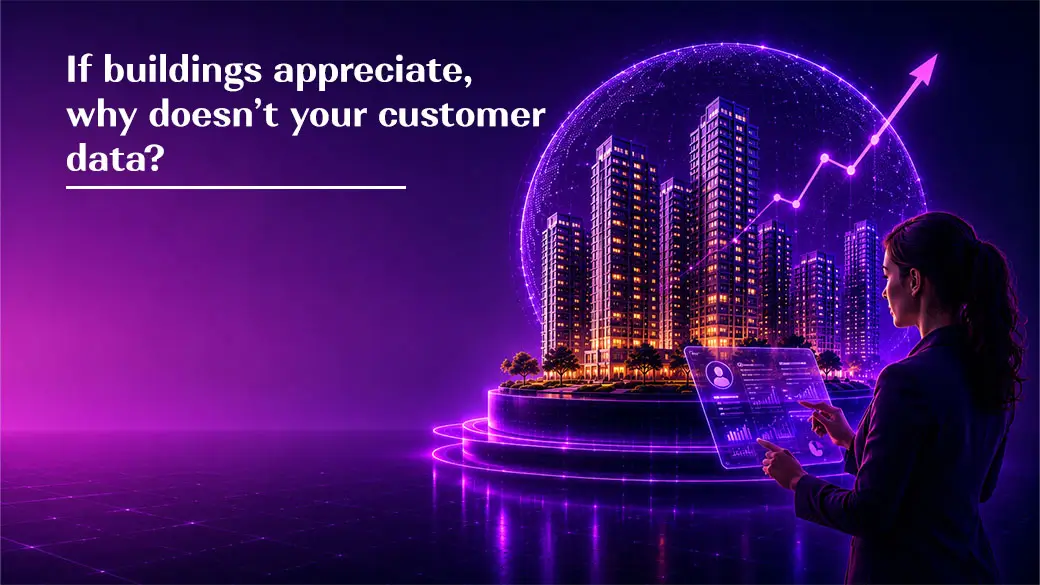
If buildings appreciate, why doesn't your customer data?
The Most Expensive Asset in Real Estate Isn't Land Anymore.
What's Wrong With the Way Real Estate Companies Treat Customer Data?
They treat it like a filing cabinet, not an appreciating asset.
Luxury apartments rise in value. Commercial towers generate rent. Plots create long-term wealth. Developers invest crores protecting every square foot of physical real estate. Yet the single asset most capable of multiplying future sales, customer intelligence, often decays in plain sight.
Here's the brutal truth: every day your customer database loses value. Not because records vanish, but because they become fragmented, stale, and unusable. People change: marriage, income, family size, location preference, risk appetite. If your CRM captured only a lead's first enquiry, you are selling yesterday's customer, not today's.
Why this matters now: competition is intensifying, digital marketing costs are climbing, and product differentiation is narrowing. When competitors can buy similar land and produce comparable towers, the differentiator becomes customer insight. The firms that win next decade will be those that make customer data appreciate, compounding intelligence each time someone interacts with the brand.
Isn't a CRM Supposed to Solve This Problem?
Most CRMs record transactions. Very few create intelligence.
Traditional CRMs answer operational questions: how many leads, who handled them, site visits, bookings. Those are necessary but not sufficient. Decision-makers need strategic answers that forecast revenue and growth:
- Which buyers are likely to upgrade to premium inventory in the next 12 months?
- Which campaigns create lifetime customers rather than one-time buyers?
- Which brokers consistently bring high-LTV buyers and deserve higher commissions?
- Which customers are ripe for a second purchase or a referral?
Recording history is different from predicting future revenue. Salesforce flips the paradigm: it isn't just a system to log activity; it's the operating system that connects signals across marketing, sales, finance, and service to convert raw data into actionable intelligence.
What Does Failure Look Like in Real Life?
Rebuilding the same audience for every launch and paying for it.
Imagine this: marketing runs campaigns and generates 40,000 enquiries. Sales qualifies 8,000. Some site visits convert. The project sells. Then, 39,000 prospects fade into silos, WhatsApp threads, Excel sheets, dusty email folders until the next launch. Marketing spends crores again to generate the same audience.
This is operational bankruptcy disguised as activity. It inflates cost per acquisition, lengthens sales cycles, creates discounting pressure, and causes unpredictable forecasting. Worse, it wastes one of the company's most strategic assets: longitudinal relationships with potential buyers.
Why Is This Happening Across So Many Departments?
Because everyone owns data and nobody owns intelligence.
Marketing runs campaigns. Sales runs deals. Finance tracks collections. Legal manages documentation. Support handles complaints. Leadership wants strategy. Each group creates its own record of the customer. The result: multiple versions of truth, no single customer timeline, and no centralized authority for customer intelligence.
Silos cause friction: duplicate outreach, fragmented customer experiences, and lost revenue opportunities. When teams don't share a single view of a customer, trust evaporates and decisions become reactive rather than prescriptive.
Isn't AI the Silver Bullet?
AI helps, but only when it has a clean, connected foundation.
There's enthusiasm and hype for AI across real estate. But AI without structured, permissioned, and relational data is like hiring a world-class architect and giving them random bricks. Machine learning needs history, relationships, context, and correct permissions to create value. Without a tidy data foundation, AI produces mediocre outcomes and undermines confidence.
Salesforce changes this equation by creating the context AI needs: unified profiles, relationship graphs, event timelines, and consent-aware data. That's why leaders who pair Salesforce with AI unlock predictive lead scoring, propensity models for upsell, and automated outreach that actually feels personal.
How Does Salesforce Make Customer Data Appreciate?
By connecting every interaction into a single customer timeline and activating it across the enterprise.
Here's what appreciation looks like in practice:
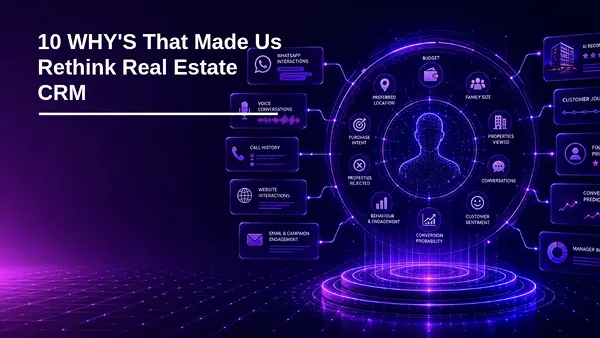
- Unified Customer Profile: Every interaction, ads clicked, chats, calls, site visits, payments, complaints, lands on one timeline. No more fragmented histories.
- Predictive Intelligence: AI models use that timeline to predict who's ready to buy next, who will respond to which incentive, and who will refer.
- Cross-departmental Activation: Marketing targets audiences based on predicted LTV; sales prioritizes high-propensity buyers; finance forecasts revenue and designs payment plans; support reduces churn by proactively resolving at-risk accounts.
- Continuous Enrichment: Each new interaction enriches the profile, improving model accuracy and enabling compounding intelligence.
When customer intelligence compounds this way, the database behaves like an appreciating asset. Each interaction adds value, reduces future acquisition costs, and accelerates time-to-sale.
Can You Give Me a Tangible Example Developers Will Relate To?
Yes, two short scenarios.
Scenario 1: The Forgotten Broker. A broker brings in high-intent buyers consistently, but their deals are spread across multiple projects and months. Without a unified system, their contribution looks intermittent. Salesforce aggregates the broker's history across projects, measures true LTV sourced by that partner, and automates tiered commissions and attention. Result: retention of a high-value channel, more referrals, and lower acquisition cost.
Scenario 2: The Returning Prospect. A buyer first interacted in 2019, downloaded a brochure, and didn't convert. They re-engaged in 2021, bought elsewhere, and returned in 2026. Traditional tools show fragmented interactions. Salesforce presents a single relationship: previous campaign touchpoints, budget growth, family profile changes, broker involvement, service interactions, and current buying signals. Sales doesn't cold-call a stranger; they continue a conversation, conversion happens faster, with less discounting.
How Much Does This Really Impact the P&L?
More than you think. Substantial line items change.
- Marketing Efficiency: Stop buying the same audience again and again. Target high-propensity segments, reduce wasteful ad spend, and improve campaign ROI.
- Sales Productivity: Prioritize deals that close faster and at higher value. Reduce lead leakage and shorten sales cycles.
- Forecast Accuracy: Finance can project cash flows with confidence, reducing working capital surprises and allowing smarter inventory funding.
- Retention & Upsell: Post-sales service triggers retention programs and identifies second-purchase opportunities, increasing lifetime value.
- Reduced Operational Debt: Less manual reconciliation across spreadsheets, fewer missed communications, fewer duplicate incentives.
In short: cleaner data, connected processes, and predictive intelligence directly improve revenue, margins, and valuations.
But Salesforce Is Big; Will It Fit a Real Estate Firm?
The right question isn't whether Salesforce is big; it's whether your business can afford enterprise visibility.
Developers today juggle multiple projects, cities, channel ecosystems, digital campaigns, collections, legal workflows, and service operations. Managing these with disconnected tools creates operational debt that compounds faster than any interest rate. Salesforce reduces that debt by unifying workflows, standardizing processes, and delivering a single source of truth that scales.
Salesforce is modular: start with a focused rollout (lead-to-booking, broker management, revenue forecasting) and expand. You get immediate wins: better targeting, fewer duplicate efforts, improved forecasting, while building a platform for long-term customer appreciation.
How Do You Start, Practically?
Treat customer intelligence as an asset with a lifecycle: Connect, Clean, Protect, Enrich, Activate.
- Connect: Integrate all touchpoints, website, ads, portals, chat, WhatsApp, offline visits, into a single timeline.
- Clean: Deduplicate records, normalise fields, and resolve identity (email, phone, PAN, Aadhaar where permitted).
- Protect: Ensure consent, secure storage, and compliance with local regulations (e.g., data protection laws).
- Enrich: Append third-party data (credit scores, property ownership histories) and internal signals (payment history, service requests).
- Activate: Use unified profiles to power campaigns, priority lists, propensity models, and automated journeys.
This is not a one-off project. It's an operating model change. But even modest early wins, reduced CAC, shorter cycles, clearer forecasts, create momentum.
What Do Industry Leaders Get Right?
They think like investors.
Top developers do three things consistently:
- They measure customer intelligence as square footage, tracking acquisition cost, retention, and LTV.
- They invest in enterprise systems that connect teams and data.
- They use intelligence to make product, pricing, and marketing decisions.
When customer intelligence is treated as a core asset, measured, protected, and compounded, developers unlock a competitive moat that's hard to replicate.
What Happens If We Do Nothing?
You pay more, sell less, and leave value on the table.
Ignoring customer appreciation means rising CAC, unpredictable forecasting, more discounting, and a weaker brand experience. Competitors who invest in connected intelligence capture market share, shorten cycles, and build durable flywheels of referrals and repeat buyers. In a market where physical differentiation is narrowing, you'll be competing on cost and luck rather than insight.
How Do You Make Leadership Care?
Frame customer intelligence as enterprise value and show immediate metrics.
Leadership thinks in assets and ROI. Convert your argument into KPIs: reduced CAC, shorter sales cycle, improved forecast accuracy, higher referral rates, and increased repeat purchases. Deliver a crisp pilot: integrate one launch, measure LTV uplift, show forecast variance reduction, and quantify savings in marketing spend. Results speak louder than slides.
Final Thought: The Next Decade Will Reward Intelligence Over Volume
For decades, real estate wealth was measured with physical metrics: acres, towers, inventory, revenue. Tomorrow, institutional customer intelligence becomes the fifth metric. Buildings can be copied; locations matched; designs emulated. But a deeply connected customer ecosystem built over years, enriched by interactions, and activated across the enterprise creates a competitive fortress.
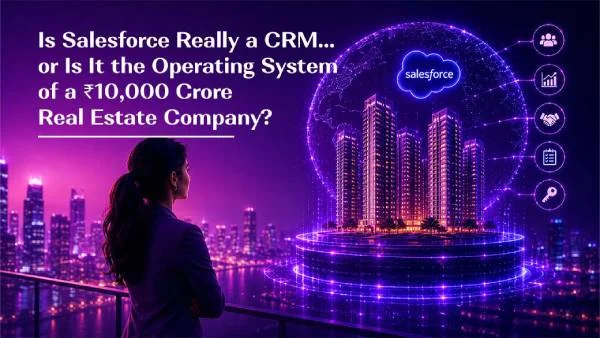
Salesforce is not just a CRM. It is the operating system of customer growth. It turns records into relationships, relationships into intelligence, intelligence into predictable revenue, and predictable revenue into enterprise value.
If your buildings appreciate every year, what are you doing to make sure your customer data does too?
Act now: connect your data, clean it, protect it, enrich it, and activate it. Your next launch shouldn't rebuild an audience. It should leverage a compounding asset.
Are you ready to stop selling to strangers, and start selling to appreciating customers?