
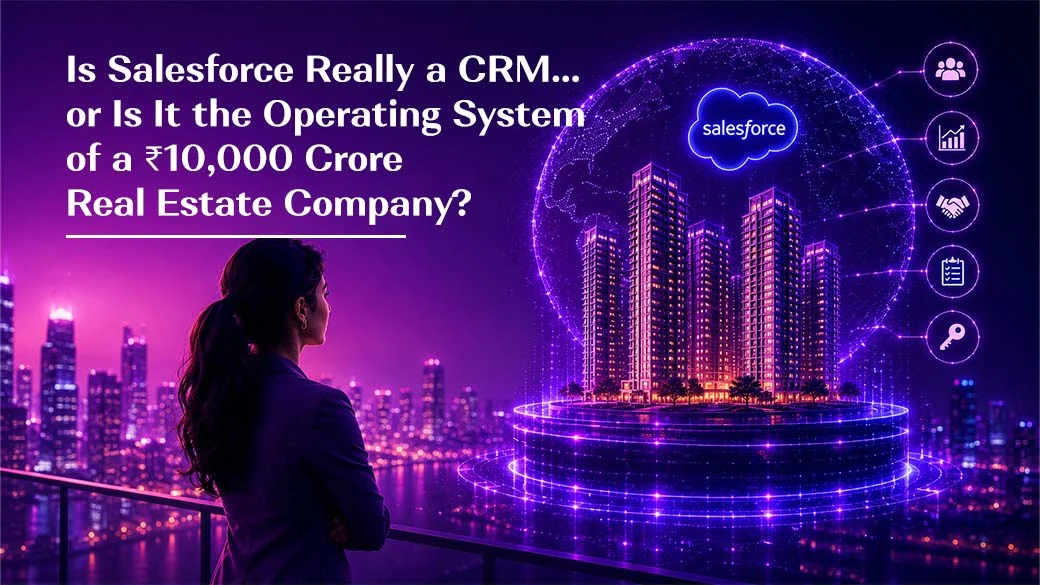
Is Salesforce Really a CRM… or Is It the Operating System of a ₹10,000 Crore Real Estate Company?
Everyone Calls Salesforce a CRM. The Smartest Developers Don't.
Walk into the boardroom of any large real estate company and ask one simple question:
'What software runs your business?'
You'll hear familiar names. One platform for leads. Another for sales. Another for finance. Another for customer service. One for legal documentation. One for construction. One for marketing automation. One for channel partners. One for customer communication.
By the time the CIO finishes answering, you'll realize something shocking.
The company isn't running one business.
It's running 15 disconnected businesses.
Now ask a different question.
'If all these softwares disappeared tomorrow morning, could your company still operate?'
Silence.
Because somewhere between generating a lead and handing over a home, information gets trapped inside systems that don't speak to each other.
Marketing celebrates lead numbers.
Sales celebrates bookings.
Finance celebrates collections.
Projects celebrate construction milestones.
Customer Service celebrates ticket closures.
But the customer experiences none of those departments.
They experience one developer.
And that's exactly why the biggest real estate companies are no longer buying software.
They're building Operating Systems.
That's where Salesforce changes the conversation.
Not because it's another CRM.
Because it's the platform your entire organization begins to breathe through.
Why Do Companies Still Think Salesforce Is Only for Sales?
Because that's how most CRMs introduced themselves.
Customer Relationship Management.
The name itself limits the imagination.
For years, companies believed CRM meant storing leads, assigning follow-ups and tracking sales activities.
That belief may have worked when developers managed two projects, five salespeople and a few hundred leads every month.
It completely breaks when you're managing:
- 18 projects across multiple cities
- Thousands of channel partners
- Hundreds of employees
- Multiple brands
- Crores of marketing spends
- Thousands of customers at different stages of their buying journey
At that scale, the challenge isn't managing customers.
The challenge is managing the business itself.
Salesforce stops being a CRM the moment every department begins working inside it.
Now Marketing doesn't just generate leads.
It generates accountable revenue.
Sales doesn't just close bookings.
It collaborates with finance, legal and projects.
Customer Service doesn't solve tickets.
It strengthens lifetime customer relationships.
Leadership doesn't receive reports.
They receive live business intelligence.
The difference sounds subtle.
The impact is transformational.
What Happens When Finance, Marketing, Sales, CRM, Legal, Projects and Customer Service Work Inside One Platform?
Imagine a customer named Rahul.
Rahul clicks your Instagram advertisement.
Normally, this is where fragmentation begins.
Marketing captures the lead.
Sales exports it into another CRM.
Finance tracks payment somewhere else.
Legal prepares documentation using different software.
Construction updates project progress manually.
Customer Service receives complaints through email.
Every department knows Rahul.
Yet nobody knows Rahul completely.
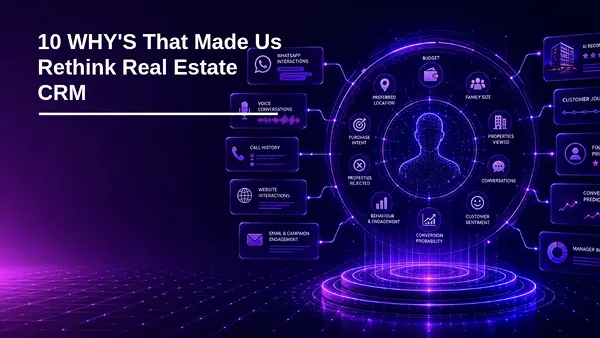
Now imagine Salesforce connecting every interaction.
Marketing knows which campaign Rahul responded to.
Sales knows every conversation.
Finance knows every payment.
Legal knows documentation status.
Projects know possession timelines.
Customer Service knows previous complaints.
Leadership knows profitability.
Suddenly Rahul isn't moving across departments.
The departments move around Rahul.
That's what an Operating System does.
It creates one source of truth.
- No duplicate data
- No version confusion
- No endless Excel files
- No 'I'll check and get back'
Just decisions backed by real-time visibility.
Why Are Developers Still Buying Software Instead of Building an Operating System?
Because software solves departments.
Operating Systems solve businesses.
Think about your smartphone.
You don't install separate operating systems for calling, messaging, photos and navigation.
Everything runs on one foundation.
Yet many developers still operate like this:
- Marketing Software
- CRM
- ERP
- Finance Tool
- Construction Tool
- Customer Care Tool
- WhatsApp Platform
- Document Platform
- BI Dashboard
- Excel
The more software you buy, the more integration problems you create.
Eventually, the organization spends more time connecting systems than serving customers.
Every new software promises efficiency.
Every new software creates another data island.
Salesforce approaches the problem differently.
Instead of asking:
'Which software do you need?'
It asks:
'How should your company function?'
That's a fundamentally different philosophy.
One buys technology.
The other designs an enterprise.
If Salesforce Disappeared Tomorrow, Would Your Company Stop Functioning?
It's an uncomfortable question.
But it's also the most important one.
If removing one platform brings your business to a halt, it means that platform isn't software anymore.
It's infrastructure.
That's exactly where large enterprises want to be.
Not dependent on dozens of disconnected applications.
Dependent on one connected ecosystem.
The world's largest organizations don't adopt Salesforce because they need another CRM.
They adopt it because they need an operating backbone capable of supporting every future business process.
As your company grows…
You don't keep changing systems.
You simply extend the same foundation.
That's scalability.
Not adding more tools.
Adding more possibilities.
The Hidden Cost Nobody Calculates
Developers love calculating acquisition cost.
Construction cost.
Approval cost.
Interest cost.
But very few calculate fragmentation cost.
Fragmentation cost is invisible.
It's the sales executive following up twice because data didn't sync.
It's finance chasing payments already made.
It's legal waiting for missing customer documents.
It's marketing unable to identify which campaign actually created revenue.
It's customer service asking buyers to repeat information they already shared.
It's management waiting three days for reports that should have taken three seconds.
Individually these seem small.
Collectively they cost crores every year.
The tragedy?
Most companies never see this number because no software measures it.
An Operating System eliminates it.
The Difference Between Data and Decisions
Many organizations proudly claim they are data-driven.
But here's a better question.
Can your leadership team make decisions instantly?
Having dashboards isn't enough.
Having reports isn't enough.
Having AI isn't enough.
If every board meeting still starts with:
'Give me last month's numbers…'
...your business is still looking backwards.
An Operating System shows what is happening now.
- Which projects are slowing?
- Which campaigns are wasting money?
- Which channel partners are delivering quality bookings?
- Which customers are likely to cancel?
- Which collections are delayed?
- Which approvals are stuck?
- Which departments are creating bottlenecks?
Data informs.
Visibility transforms.
Salesforce delivers visibility.
A Real Estate Company Running 18 Projects Across India
Let's imagine a developer managing eighteen projects across multiple cities.
Every project has:
- Separate sales teams
- Separate marketing campaigns
- Multiple channel partners
- Hundreds of vendors
- Thousands of customers
- Multiple banks
- Legal approvals
- Collection milestones
- Construction updates
Traditionally, each department would purchase specialized software.
Within three years, the company ends up managing fourteen disconnected applications.
Leadership has no unified visibility.
Departments blame each other.
Customers experience delays.
Reports become negotiations instead of facts.
Now imagine replacing those fourteen systems with one connected ecosystem.
Every customer interaction is connected.
Every payment is visible.
Every approval is tracked.
Every campaign is measurable.
Every employee works on the same data.
Every leadership decision is based on reality instead of assumptions.
That's not digital transformation.
That's business transformation.
Salesforce Isn't Replacing People. It's Removing Friction.
One of the biggest misconceptions about enterprise technology is that automation replaces employees.
It doesn't.
It removes repetitive work.
Sales teams spend more time selling.
Finance spends less time reconciling.
Marketing spends less time guessing.
Customer Service spends less time searching.
Management spends less time waiting.
People become more valuable because systems become smarter.
Technology should never replace judgment.
It should amplify it.
The Companies That Will Win the Next Decade
The next generation of real estate leaders won't compete only on location, pricing or amenities.
They'll compete on operational intelligence.
Customers will expect instant updates.
Investors will expect predictable numbers.
Leadership will expect real-time decisions.
Employees will expect connected workflows.
Developers still running disconnected systems will spend the next decade fixing yesterday's problems.
Developers building Operating Systems will spend the next decade creating tomorrow's opportunities.
That's the difference.
The Question Every Promoter Should Ask
Not:
'Do we need another CRM?'
Ask instead:
'Can our business continue to scale without an Operating System?'
Because eventually every growing organization reaches a point where more software creates more complexity.
The smartest developers recognize that point early.
The rest discover it after growth becomes difficult.
Final Thought: The Companies That Shape the Future Don't Buy More Software. They Build Better Businesses.
Salesforce isn't valuable because it stores customer information.
It's valuable because it connects every function that creates customer value.
The companies that dominate tomorrow's real estate market won't necessarily have the biggest marketing budgets, the largest sales teams or the tallest towers.
They'll have something far more powerful.
A business where Marketing, Sales, Finance, Legal, Projects and Customer Experience operate as one synchronized system instead of isolated departments.
That's no longer a CRM.
That's an Operating System.
And once you've experienced a business that runs on a connected Operating System, going back to disconnected software feels like trying to build a skyscraper with hand tools.
The real question isn't whether Salesforce is a CRM.
The real question is this:
Is your company still buying software while your competitors are building an Operating System?
Because in the coming decade, the developers who answer that question correctly won't just sell more homes.
They'll build the companies everyone else tries to catch.