
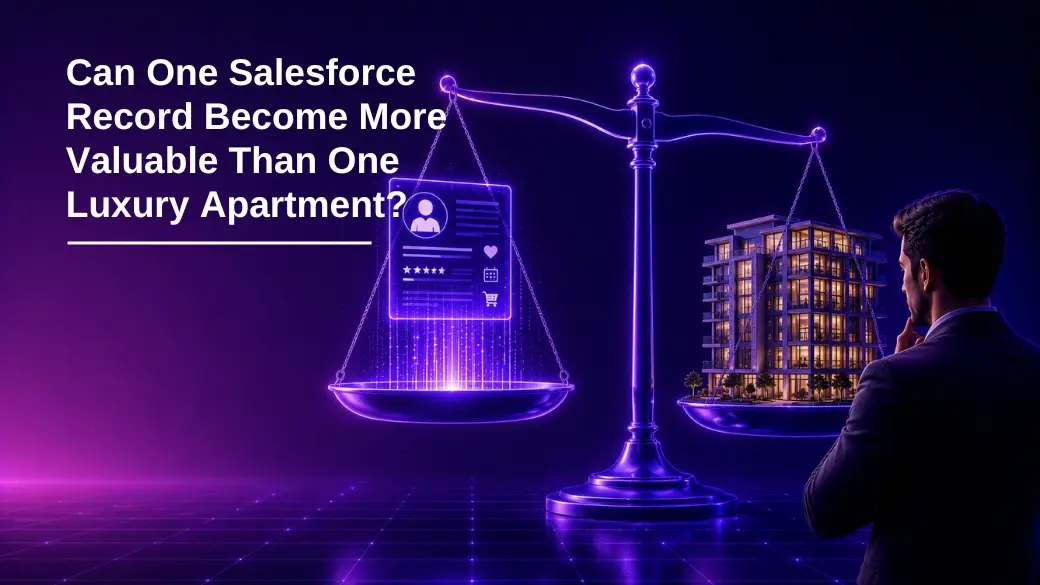
Can One Salesforce Record Become More Valuable Than One Luxury Apartment?
A luxury apartment is a finite asset that can be sold once; a well designed Salesforce record is a living asset that can influence revenue, retention, referrals, and future projects for years.
The Record Nobody Puts on the Balance Sheet
A luxury apartment may be worth ₹5 crore, ₹10 crore, or considerably more. It has a location, a view, a floor plan, a payment schedule, and a buyer waiting to make one of the most important decisions of their life.
A Salesforce record appears far less impressive. It may contain a name, a phone number, a campaign source, a budget, a preferred configuration, a site visit date, a conversation transcript, an objection, a payment status, and a next action.
On a spreadsheet, the apartment looks like an asset. The record looks like administration. That is the illusion.
A luxury apartment can create revenue once. A properly structured Salesforce record can help create revenue before the apartment is sold, protect the relationship after booking, generate referrals during construction, improve the next project's design, sharpen marketing allocation, and teach an AI system what to do next.
The apartment is inventory. The record is intelligence. And in the next era of real estate, intelligence may become a more valuable asset.
Why Is a Record More Than a Record?
Most real estate companies treat customer records as static files. A lead enters the system, a sales executive calls, a site visit is scheduled, and the record is updated, if someone remembers. That is not customer intelligence. It is digital paperwork.
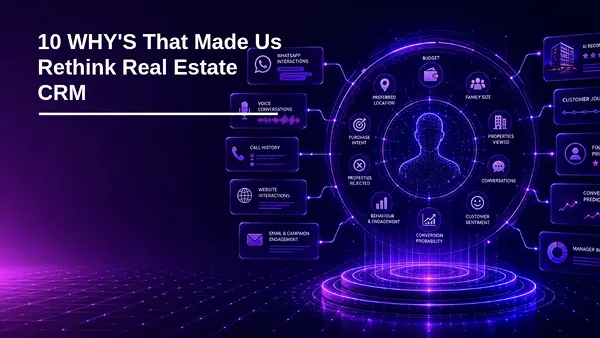
A valuable Salesforce record is longitudinal. It remembers the entire relationship:
- Where the buyer first discovered the project.
- Which campaigns and messages created engagement.
- The unit types, floors, views, and amenities they explored.
- Who else influences the decision?
- What budget and payment concerns they expressed.
- Whether they attended a site visit.
- What happened during and after that visit.
- Which objections delayed the decision.
- Whether the buyer booked, cancelled, referred someone, or purchased again.
- How the buyer experienced the developer during construction and possession.
The record becomes a continuously updated model of intent.
The Salesforce book describes the central principle behind this transformation: a single source of truth is not a feature that can simply be switched on. It is an organisational discipline in which every customer facing team reads from and writes to one authoritative record.
When that discipline exists, a record stops being a container for information. It becomes a decision engine.
What Makes a Record Commercially Valuable?
Data becomes valuable when it changes an action.
A buyer's budget is useful if it helps recommend the right unit. A site visit history is useful if it triggers a timely follow up. A payment pattern is useful if it identifies financial anxiety before cancellation. A campaign source is useful if it reveals where the next ₹1 crore should or should not be invested.
A record's value comes from four qualities:
- Completeness: It captures the full journey instead of one isolated interaction.
- Accuracy: Teams trust what they see and act on it.
- Timeliness: Information is available while a decision can still be influenced.
- Connectivity: The record links marketing, sales, inventory, service, finance, and delivery.
A record with a name and phone number is a contact. A record with context, history, intent, and next best action is an asset.
Can One Record Influence More Than One Apartment?
Absolutely.
Suppose a prospective buyer enquires about a premium 3BHK. The buyer mentions that they want a higher floor, an open view, a possession timeline within three years, and a payment plan that reduces the initial burden. They visit the project with their spouse and parents. During the conversation, they raise concerns about construction quality and compare a competing development nearby.
A basic CRM records 'interested in 3BHK.'
A correctly architected Salesforce record captures a much richer commercial picture:
- The buyer is likely to value the view and trust more than the lowest price.
- The family is part of the decision network.
- The possession timeline is a qualification condition.
- The buyer may need financing support.
- The sales executive should follow up quickly after the site visit.
- The message should focus on construction transparency, not generic amenities.
- Similar units should be recommended if the original unit is unavailable.
- A stalled conversation may require a different intervention from a price sensitive lead.
This one record can influence the sale of multiple units, not by sending the same buyer multiple irrelevant offers, but by teaching the organisation how buyers like this behave.
When thousands of records are structured in the same way, the organisation starts to understand demand before demand becomes obvious. That is the beginning of predictive real estate.
Why Does Real Estate Create Unusually Valuable Records?
Because the journey is long, emotional, and data rich.
In many industries, the customer buys and leaves. In real estate, the relationship may extend from first inquiry through booking, agreement, construction, possession, service, referral, and future purchase. The Salesforce book identifies real estate as four connected businesses operating together: marketing, sales, construction and delivery, and channel management.
Each business creates a different category of intelligence.
- Marketing reveals what attracts attention.
- Sales reveals what creates trust and hesitation.
- Construction communication reveals what protects or damages confidence.
- Channel management reveals which partners influence high value buyers.
When these signals are connected, the record becomes a living history of the buyer's relationship with the developer.
This matters because the transaction does not end at booking. A buyer who feels informed during construction can become an advocate. A buyer who feels ignored may become a detractor, regardless of the quality of the apartment itself.
The book makes the point sharply: in real estate, silence during construction does not create neutrality. It creates fear.
A Salesforce record can ensure that silence is replaced with relevant, proactive communication.
How Can a Record Protect Revenue After Booking?
Booking is not the finish line. It is the beginning of the most sensitive phase.
The buyer may now need payment reminders, construction updates, document access, legal clarity, possession information, and rapid answers to questions. Every unanswered query adds uncertainty. Every inconsistent response weakens trust.
Service Cloud can convert these interactions into structured cases with ownership, priority, status, service level expectations, and complete history. Experience Cloud can give buyers access to payment schedules, receipts, documents, construction updates, and service requests. Marketing Cloud can orchestrate personalised communications based on the buyer's project, unit, payment status, and journey stage.
The result is not merely better administration. It is relationship protection.
A buyer who receives a timely answer may remain confident. A buyer whose issue is forgotten may delay a payment, raise an escalation, discourage a referral, or reconsider the developer for a future purchase.
One booking creates revenue. One intelligently managed record helps protect the revenue, the reputation, and the next opportunity.
What Is the Hidden Gold in Historical Records?
Every developer has a history of decisions trapped in disconnected systems.
There are old leads in spreadsheets, site visits in separate applications, campaign data in advertising platforms, conversations in WhatsApp, payment records in ERP systems, and customer complaints in email inboxes. The organisation possesses enormous data but lacks a unified identity.
The book calls this a defining paradox of Indian real estate: data rich organisations making data poor decisions.
Historical Salesforce records can reveal:
- Which sources generate bookings rather than just leads.
- Which projects attract high intent buyers.
- Which unit configurations convert fastest.
- Which objections most frequently delay booking.
- Which sales executives convert site visits effectively.
- Which channel partners produce quality business.
- Which post booking messages increase engagement.
- Which signals appear before cancellation or referral.
This is not backward looking reporting. It is training material for the future.
A project that analyses its previous launch can improve its next launch. A developer that learns from hundreds of conversations can improve its scripts, campaigns, inventory strategy, and product design.
The first record may describe one buyer. A thousand connected records describe the market.
Can a Salesforce Record Influence Project Design?
This is where the record's value moves beyond sales.
Imagine a developer analysing thousands of site visits. With proper consent and privacy controls, the organisation can study which parts of a sample apartment attract attention, which amenities create questions, which features generate positive reactions, and which expensive design elements buyers barely notice. The book describes how voice and site visit data can be transformed into structured intelligence inside Salesforce.
Now combine those observations with:
- Unit preferences.
- Budget ranges.
- Booking outcomes.
- Cancellation patterns.
- Family feedback.
- Location objections.
- Post possession satisfaction.
The developer can make better decisions about future projects, not based only on instinct, competitor brochures, or internal assumptions, but on observed buyer behaviour.
That is a radical shift. The record is no longer only helping sell what has already been built. It is helping decide what should be built next.
A luxury apartment is a finished proposition. A connected record can improve the proposition itself.
How Does Attribution Change the Value of a Record?
A booking may appear to come from one source, but the journey often includes several.
A buyer may discover a project through a digital advertisement, speak to a channel partner on WhatsApp, attend a site visit arranged by an internal executive, and finally book after receiving a personalized follow up. Who deserves credit?
In many organisations, the answer is impossible to establish because each interaction is stored in a different place.
The Salesforce book correctly frames attribution as a data architecture problem, not a reporting problem. If the architecture is broken, better dashboards only produce better looking confusion.
A connected record can preserve the full path to conversion:
- First touch source.
- Campaign engagement.
- Partner involvement.
- Site visit ownership.
- Sales activity.
- Conversion influence.
- Final booking channel.
This changes budget decisions and partner economics. Marketing spend can move toward channels that produce quality conversions. High performing channel partners can be identified and rewarded. Sales managers can see which interventions actually move buyers forward.
The record becomes commercially defensible evidence.
Can AI Make the Record Even More Valuable?
AI does not create value from nothing. It multiplies the value of clean, connected data.
Einstein can identify patterns in historical lead and opportunity data, score propensity, flag cancellation risk, and surface likely next actions. Voice integrations can transcribe calls and extract budgets, objections, timelines, commitments, and sentiment. Agentforce can use permitted Salesforce data to qualify leads, answer buyer questions, route opportunities, and update records.
Consider the difference between these two records:
Record A: 'Interested. Follow up next week.'
Record B: 'Buyer prefers 3BHK, higher floor, open view. Spouse is co decision maker. Budget concern raised after site visit. The possession deadline is a priority. The buyer engaged with construction updates and opened financing communication. Recommended action: offer alternate higher floor unit with revised payment schedule; schedule family focused follow up within 24 hours.'
An AI system can act on Record B. It has nothing meaningful to work with in Record A.
This is why developers should not rush to buy AI before fixing the foundation. An agent reading stale inventory can confidently recommend a sold apartment. An agent reading incomplete lead history can qualify a buyer incorrectly. Intelligence without architecture creates automated error at scale.
What Will Developers Who Delay Lose?
They may not lose one deal immediately. They will lose the compounding advantage.
Every month, a data disciplined organisation captures more behavioural signals. Every launch improves its lead scoring. Every conversation strengthens its objection library. Every site visit improves its understanding of buyer preferences. Every post booking interaction refines its service and referral strategy.
Meanwhile, a competitor operating through scattered spreadsheets remains dependent on memory, individual talent, and manual reporting.
The difference widens quietly.
By the time the lagging developer decides to implement Salesforce properly, the leading developer may already possess years of structured data, tested workflows, trained teams, integrated channels, and AI ready records.
This is the real FOMO, not that one competitor has a better dashboard, but that one competitor is building an intelligence advantage that becomes harder to reproduce every day.
What Should a CEO Measure?
Not the number of licences purchased. Not the number of dashboards created. Not even the number of records stored.
Measure whether records are becoming useful.
Leadership should track:
- Percentage of records with complete source attribution.
- Speed from enquiry to first meaningful response.
- Site visit follow up compliance.
- Percentage of inventory represented accurately in real time.
- Lead to site visit and site visit to booking conversion.
- Revenue influenced by channel partners.
- Service response and resolution times.
- Referral contribution from existing buyers.
- Percentage of records with a clear next action.
- Adoption by the teams expected to use Salesforce.
The book offers an important warning: licences are not usage, usage is not adoption, and adoption is not value.
Value appears when a record changes what the organisation does next.
So, Can One Record Really Be Worth More Than One Luxury Apartment?
Not in the simplistic sense that a database entry has a guaranteed monetary price.
But a high quality Salesforce record can influence far more economic value than a single transaction. It can help sell a unit, prevent a cancellation, protect a relationship, generate a referral, allocate marketing spend, improve inventory decisions, inform project design, and train AI systems that serve future buyers.
The apartment creates a moment of revenue. The record creates a system of repeatable advantage.
That is why CEOs should stop asking, 'How many leads are in our CRM?' The better question is: 'How many future decisions are hidden inside the records we already own?'
Closing Thought: The Asset That Appreciates by Learning
A luxury apartment appreciates through location, scarcity, demand, and time.
A Salesforce record appreciates through context.
The more accurately it captures the buyer's journey, the more useful it becomes. The more useful it becomes, the more decisions it can improve. The more decisions it improves, the more intelligence the organisation accumulates.
One apartment can be sold once. One connected record can help an organisation sell better apartments, to better qualified buyers, through better channels, with better timing, again and again.
The most expensive asset in your business may be the one you can walk through.
The most valuable may be the one your team is still calling 'just a lead.'