
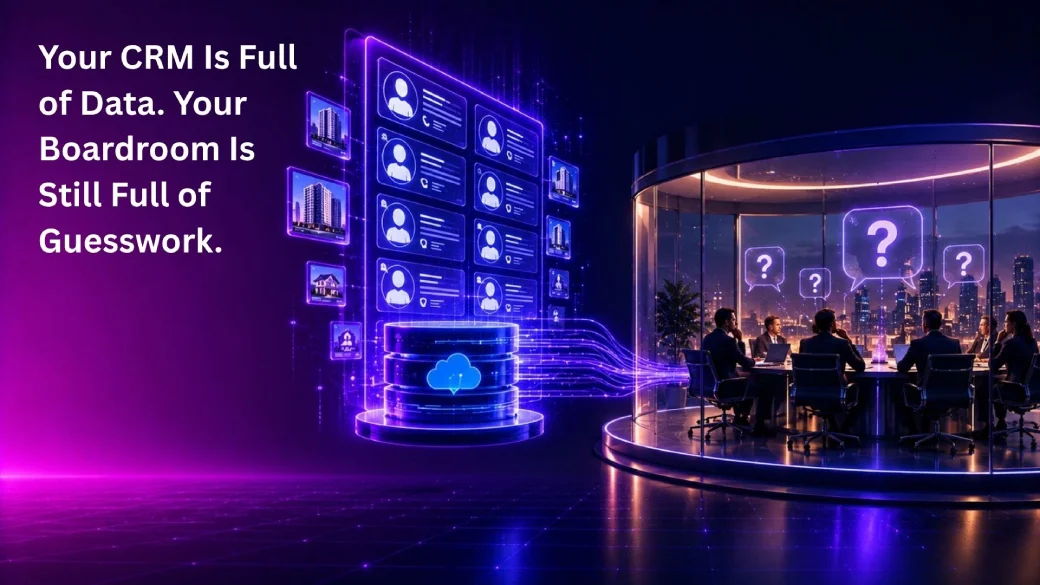
Your CRM Is Full of Data. Your Boardroom Is Still Full of Guesswork.
If your leadership still has to ask Marketing, Sales, and Brokers what happened to a deal, you do not have a CRM - you have a database that witnessed the loss.
The meeting that exposes the gap
The boardroom is quiet.
The CEO asks a simple question:
“We booked 120 units last month. Where did the other 380 qualified opportunities go?”
Marketing points to campaign reports.
Sales points to pipeline stages.
Channel partners point to referrals and WhatsApp conversations.
Finance points to booking records.
Everyone has data.
Nobody has the story.
This is the moment where technology reveals its limits. A CRM can store records, but it cannot force clarity. It can capture activity, but it cannot explain outcomes. It can show dashboards, but it cannot guarantee that the numbers are trusted.
ACX Totality is built for precisely this problem. Its stated purpose is to move developers from fragmented systems and guesswork to predictable growth by connecting every person, process, and technology touchpoint across the sales journey.
The question is not whether you have a CRM.
The question is whether your CRM gives your boardroom visibility - or just more slides.
Why does data not become visible?
Because visibility requires more than fields and forms.
It requires:
- A shared definition of every stage.
- Consistent updates at every moment.
- Connected systems that agree on the truth.
- Attribution that survives handoffs.
- Leadership that insists on using one source of reality.
- Operational ownership that ensures adoption.
Most developers already see activity.
They see leads flowing in from multiple channels. They see agents making calls and site visits. They see proposals being sent. They see bookings being recorded. They see monthly reports that tell an incomplete story.
What they cannot answer is more important:
- Which channel produced the highest-quality leads?
- At which stage did the lost deals drop off?
- Which agent behaviour drives the highest conversion?
- What is the true cost per acquisition by project?
- Can we replicate our best-performing sales motion?
Without answers, growth remains unpredictable and scale becomes chaotic rather than compounding.
Data without visibility is not intelligence.
It is noise with a login screen.
What is the difference between a database and a CRM that creates clarity?
A database stores information.
A clarity-creating CRM connects information to decisions.
A database can tell you:
- How many leads were created.
- How many calls were logged.
- How many site visits occurred.
- How many bookings were recorded.
A clarity-creating CRM can tell you:
- Which leads became conversations and which did not.
- Which conversations turned into visits and why.
- Which visits received timely follow-up and which disappeared.
- Which proposals matched buyer requirements and which were generic.
- Which bookings came from which channel and agent.
- Where revenue was lost in the chain and what to change next month.
ACX Totality is positioned not as a better CRM, but as a sales infrastructure designed to track outcomes rather than activity, start at attribution rather than stop at booking, and measure business results rather than logins.
That distinction matters in the boardroom.
A database answers, “What happened?”
A clarity system answers, “Why it happened, and what we will do differently.”
Where does guesswork enter the sales journey?
Guesswork enters wherever the journey is invisible.
Consider a typical real estate sale. It moves through seven critical links:
- Lead.
- Contact.
- Conversation.
- Visit.
- Proposal.
- Booking.
- Attribution.
ACX Totality calls these the 7 Links of Every Sale. Each link is a moment where revenue can be won or lost. Each link is a point where guesswork can enter if the system does not make it visible, measurable, and optimisable.
Now imagine the gaps:
- A lead arrives, but the source is overwritten as “Direct.”
- A contact attempt is logged, but the outcome is unclear.
- A conversation happens, but budget, timeline, and decision-makers are not recorded.
- A visit occurs, but no structured follow-up is triggered.
- A proposal is sent, but it does not reflect the buyer's actual needs.
- A booking is made, but channel and agent credit are disputed.
- A lost deal disappears without a clear reason.
At each gap, someone in the boardroom will eventually ask, “What happened?”
If the system cannot answer, guesswork fills the silence.
Why do traditional CRM implementations fail to remove guesswork?
Because they often stop at deployment.
The software goes live, but nobody redesigns how the team actually works. Old habits persist inside new tools. Reports exist, but trust does not. Users are trained, but habits are not. The CRM goes live, but adoption does not.
ACX Totality's product material describes this failure pattern explicitly:
- The software goes live, but nobody redesigns how the team actually works.
- Reports exist. Trust doesn't.
- Users are trained. Habits aren't.
- CRM goes live. Adoption doesn't.
Without a dedicated owner driving accountability, the CRM becomes shelfware - expensive, unused, and ultimately abandoned.
This is why many boardrooms remain full of guesswork even after a CRM implementation.
The technology was installed.
The operating system was not.
How does ACX Totality turn data into boardroom clarity?
By treating sales as an engineered chain rather than a collection of activities.
Totality is built around four operating laws:
- Every sale has 7 links.
- The weakest link determines revenue.
- What you can attribute, you can repeat.
- Adoption determines ROI.
These laws shift the conversation from “How many leads?” to “Which link is limiting us?” and from “Who claims credit?” to “What can we prove drove the booking?”
The platform includes modules designed to support these links:
- Lead Management across digital, referral, walk-in, and partner channels.
- Channel Partner (CP) Management for referrals, attribution, and commission workflows.
- An Attribution Engine to assign revenue credit accurately.
- Customer Journey Tracking from first inquiry to final booking.
- A real estate-native CRM built around the 7 Links.
- Workflow Automation for follow-ups, tasks, approvals, and escalations.
- Reporting and Dashboards for response rates, contact ratios, visit conversion, proposal rates, booking conversion, and cost per acquisition.
- Mobile Applications for agents and managers in the field.
The objective is not to produce more reports.
It is to make the revenue story readable, attributable, and actionable.
What would a clarity-focused boardroom meeting look like?
Instead of asking each department to explain its slice, leadership would review the entire chain.
For every project, the dashboard would show:
| Revenue question | What the system should reveal |
|---|---|
| Are leads becoming conversations? | Contact and conversation ratios |
| Are conversations creating visits? | Qualification and visit conversion |
| Are visits becoming proposals? | Visit-to-proposal performance |
| Are proposals creating bookings? | Proposal-to-booking conversion |
| Where are opportunities stalling? | Stage-level drop-off and ageing |
| Which channels create revenue? | Campaign, partner, and source attribution |
| Which teams need support? | Agent-level behaviour and conversion |
| Is the system being used? | Adoption, data quality, and workflow compliance |
The conversation changes from defence to diagnosis.
Marketing is not asked to justify spending in general terms. It is asked to explain why one channel's leads convert better than another's.
Sales is not asked to explain why bookings are low. It is asked to explain why the visit-to-proposal ratio collapsed in a specific project.
Channel partners are not asked to trust informal credit. They are shown verified attribution.
This is the difference between a database that stores activity and a system that exposes the commercial logic of the business.
Why is attribution the foundation of repeatable growth?
Because without attribution, every decision is a hypothesis.
A developer may believe that digital advertising is the primary driver of bookings. The data may show that referrals and channel partners produce a higher proportion of conversions. But if attribution is incomplete, the belief wins.
Budget flows to the loudest channel, not the best channel.
High-performing agents and partners are under-rewarded or invisible.
The organisation cannot replicate its best sales motions because it does not know which behaviours actually created the outcome.
ACX Totality treats attribution as a core operating layer. Its Attribution Engine is designed to assign revenue credit to channels, agents, and campaigns so leadership knows exactly what is driving bookings.
The principle is simple:
What you can attribute, you can repeat.
What you cannot attribute, you will fund by instinct.
What role does adoption play in removing guesswork?
Adoption is the bridge between technology and truth.
A perfect attribution model is worthless if sales executives do not record conversations. A beautifully designed dashboard is useless if managers continue requesting manual Excel reports. A lead-routing workflow cannot improve response rates if teams bypass it. A mobile application cannot improve field productivity if site visits are never updated.
Totality is engineered around adoption. It includes a Forward Deployed Operator (FDO) in its Command model, responsible for process mapping, workflow design, adoption management, attribution validation, leadership reviews, and optimisation roadmaps.
The Totality Adoption Framework follows six phases:
- Configure.
- Train.
- Monitor.
- Enforce.
- Improve.
- Institutionalise.
Success is measured not by logins, but by business outcomes: response rates, conversion ratios, attribution accuracy, and sales velocity.
This is the standard CEOs should demand.
A system should not be considered successful because it is installed.
It should be considered successful because the business behaves differently and revenue becomes more predictable.
How does Totality handle the human side of sales?
By recognising that every link is a human moment.
A lead is not a record. It is a person who raised a hand.
A contact is not a checkbox. It is a conversation that may create trust or lose it.
A visit is not a stage. It is an emotional experience that can accelerate or kill intent.
A proposal is not a document. It is a test of whether the organisation understood the buyer.
A booking is not a number. It is a commitment that must be protected through documentation, communication, and service.
Attribution is not a report. It is the organisation's memory of who influenced that commitment.
ACX Totality's Customer Journey Tracking is designed to maintain end-to-end visibility across every touchpoint, from first inquiry to final booking, with full interaction history.
This matters in the boardroom.
When leadership can see not only what happened but how it happened, coaching becomes precise. When a manager can see that an agent consistently loses deals after the visit, the intervention is not generic “sell better.” It is specific: improve follow-up, refine proposal quality, address objections earlier.
Guesswork is replaced by targeted improvement.
What happens when a developer scales across projects and cities?
Fragmentation multiplies.
One project defines “qualified” one way. Another defines it differently. One team updates visits immediately. Another updates them days later. One channel partner registers leads formally. Another relies on WhatsApp and informal promises.
Without a standardised operating model, comparison becomes impossible.
Totality's client and deployment protocols are designed to create repeatability:
Client Protocol: Find, Map, Connect, Adopt, Scale.
Deployment Protocol: Audit, Architect, Activate, Adopt, Analyse, Optimise, Scale.
Together, these protocols are intended to identify the weakest link, connect the complete sales journey, activate the platform, drive adoption, measure performance, fix bottlenecks, and expand what works.
This is how a developer stops rebuilding its sales system for every new project.
The first successful sales motion becomes a pattern.
The pattern becomes infrastructure.
The infrastructure becomes an advantage.
What should a CEO fear more: bad data or no data?
Neither.
The CEO should fear untrusted data.
Bad data can be cleaned. No data can be captured.
Untrusted data destroys decision-making. When dashboards show conflicting numbers, leadership stops relying on the system entirely. Managers return to spreadsheets. Sales teams treat the CRM as a reporting burden rather than a sales tool. The boardroom reverts to opinion.
This is why Totality emphasises that reports may exist, but trust does not, unless adoption and accountability are enforced.
A system that is not trusted is not a system.
It is a digital alibi.
What questions should a CEO ask before buying another CRM?
Ask these questions:
- Can this system show me all seven links for every deal?
- Can it identify where lost opportunities dropped out?
- Can it prove which channel and agent influenced each booking?
- Can it measure the time between lead, contact, conversation, visit, proposal, and booking?
- Can it enforce consistent stage definitions across projects?
- Can it show me adoption, not just logins?
- Can it help me replicate my best sales motion?
- Will someone own the outcome, not just the implementation?
If the answer to several questions is no, you may be buying another database.
ACX Totality is built for developers who want predictable growth rather than fragmented systems, guesswork, and missed revenue. It positions itself as the operating layer that connects people, processes, technology touchpoints, outcomes, and accountability.
Closing thought: the boardroom deserves more than slides
Your CRM may be full of data.
Your boardroom may still be full of guesswork.
The gap between them is not a technology problem.
It is an operating-system problem.
A database can store what happened.
A clarity system can explain why it happened and what to change next.
A database can show activity.
A clarity system can show outcomes.
A database can produce reports.
A clarity system can produce trust.
ACX Totality is designed for developers who refuse to leave revenue unpredictable. Its promise is direct:
Find the link. Fix the link. Scale the system.
The developers who win the next decade will not necessarily have the most data.
They will have the most trusted, attributable, and actionable view of their sales chain.
And when the CEO asks, “Where did the revenue go?”
The boardroom will not be filled with opinions.
It will be filled with answers.