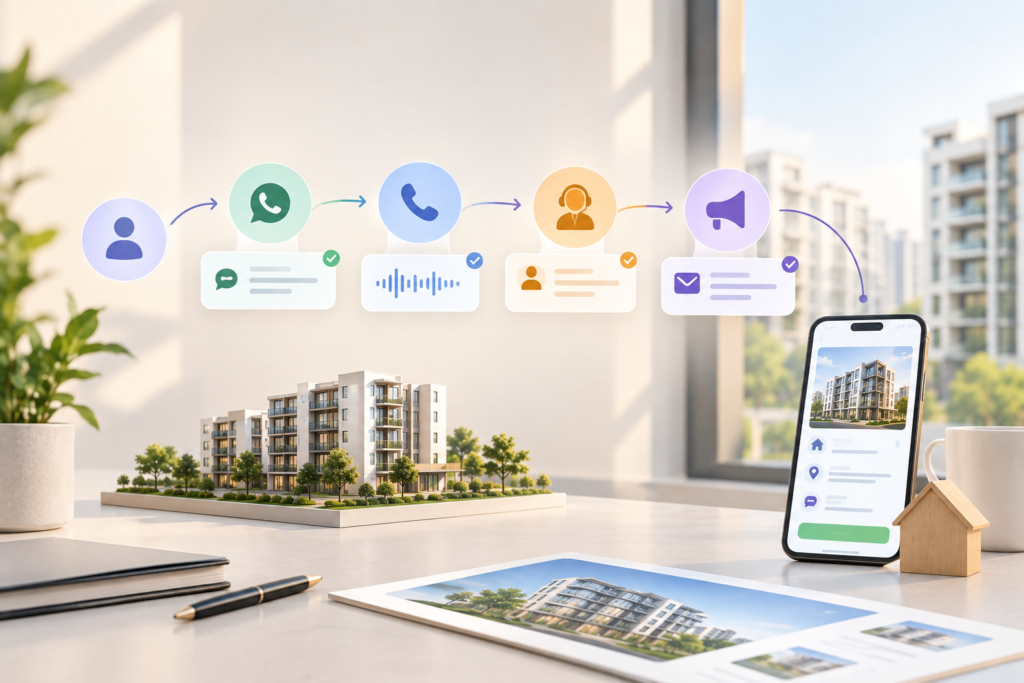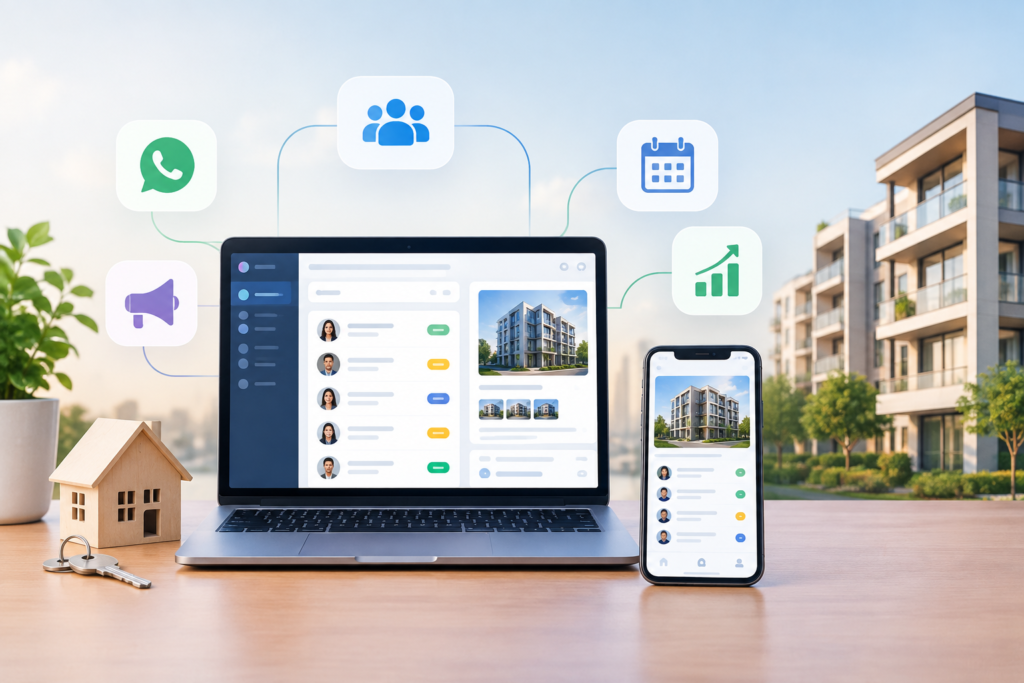

The right CRM is vital for growing real estate builders. While Sell.Do has served developers for years, disconnected data across pre-sales, site teams, and channel partners often slows response times and causes lost deals.
Today, builders need more than a digital address book. A modern sales platform must capture inquiries instantly, qualify buyer intent with voice AI within legal hours, and protect broker relationships through source locking. Most of all, it must tie every marketing rupee directly to unit bookings.
This guide reviews the top Sell.Do alternative to help you stop lead leaks, automate follow-ups, and sell inventory faster from one unified platform.
AbsoluteCX: The Complete Alternative
AbsoluteCX replaces fragmented sales tools with a unified platform designed to manage real estate operations across the entire property journey.
What it covers
Managing separate software for each team creates communication gaps and data loss. AbsoluteCX connects every stage of property sales and operations, so teams collaborate from one centralized hub.
- Pre-sales management: Capture incoming digital inquiries immediately, run early qualification, and distribute high-intent leads to pre-sales reps.
- Site sales: Handle visitor check-ins, manage floor walks, share real-time cost sheets, and block inventory live from site offices.
- Post-sales management: Send automated payment demand letters, track construction milestones, collect dues, and coordinate handover paperwork.
- Customer loyalty: Set up structured buyer referral schemes and deliver early-bird booking access to existing homeowners.
- Channel partner management: Onboard external brokers quickly, lock lead attribution to prevent ownership disputes, and track commission payouts.
- Facility management: Organize resident maintenance requests, address unit snagging lists, and coordinate ongoing property upkeep after possession.
AI layer
Manual outreach often results in delayed call attempts and missing pipeline data. The platform embeds automated intelligence directly into routine sales tasks to keep operations fast and reliable.
- Instant voice calls: The AI agent calls fresh leads within 60 seconds during TRAI-approved hours to record budget, configuration needs, and buying horizons.
- Live call transcription: Every conversation converts into text automatically, populating the buyer timeline with accurate notes and interest scores.
- Executive audit ratings: The system evaluates rep call recordings against set standards for pitch quality, objection handling, and project details.
- Data integrity checks: Automated scans identify fake site visit bookings and inaccurate call dispositions, keeping pipeline reports clean.
- Channel partner onboarding: A WhatsApp bot registers new brokers, checks submitted KYC documents, and shares approved project collateral instantly.
How one record runs the lifecycle
Property sales involve numerous touchpoints across months or years. Keeping a single record active through every department ensures no interaction history is lost along the way.
- A buyer inquires on 99acres about a 3 BHK unit. The AI voice agent calls within 60 seconds, confirms purchase intent, and locks in a weekend site tour.
- When the buyer arrives, the site sales manager pulls up the existing interaction history, conducts the walk-through, and issues a customized cost sheet.
- Upon booking, the system passes that same file to post-sales to schedule demand notes and track installment payments.
- Following handover, the resident uses their profile to submit a maintenance request, which routes straight to the facility engineering desk.
Who it is built for
Multi-stage projects require scalable inventory and structural support for regional and national developers. AbsoluteCX targets mid-to-large developers across residential, commercial, and redevelopment sectors.
What Sell.Do Does Well
Sell.Do provides a focused set of features built directly for Indian real estate sales. The platform helps developers structure early pipeline operations and run digital campaigns across multiple channels.
- Inquiry capture and Jarvis AI: Ingests leads from over 20 portals with intent scoring, using AI voice agents to qualify buyers and book site visits.
- IRIS launch platform: Manages high-demand project launches with live inventory blocking, expression of interest handling, and cost sheets.
- WhatsApp sync and collections: Automates brochure delivery, syncs audiences for ad retargeting, and schedules milestone demand notices after booking.
Integrated call analysis transcribes discussions to review agent pitch quality and keep pre-sales teams aligned.
Where builders outgrow it
As developers expand project portfolios, operational requirements naturally stretch beyond initial lead capture and pre-sales workflows.
Post-possession operations
A pre-sales engine naturally winds down once units are booked. Growing developers eventually need active tools to run helpdesks, log snagging lists, coordinate vendor contracts, manage visitor access, and handle legal handovers to resident welfare associations. When these tools live in separate applications, customer communication breaks down after possession.
Depth of AI coaching
Basic conversational transcripts do not provide the supervisory depth needed for large sales teams. Scaling builders need automated evaluations that score agent pitch quality, check objection handling, and flag dishonest behavior like fake visit bookings or manipulated disposition codes. Without these deep audits, pre-sales managers must spend hours manually spot-checking calls.
Platform extensibility
Enterprise real estate operations rely on complex back-office systems to run day-to-day work. As builders add custom inventory objects, integrate ERP platforms like SAP, and require digital Aadhaar KYC or e-signatures, standard pre-sales setups can feel rigid. Developers often require flexible data structures that adapt to unique commercial, plotted, and redevelopment workflows.
Channel partner depth
Standard partner portals capture broker submissions but rarely manage the full channel relationship. High-volume builders need automated WhatsApp onboarding bots, instant RERA license verification, tier-based commission calculations, and automated payout approvals. Without deep partner tools, finance and sales teams waste significant time auditing broker claims manually.
Marketing and data on one platform
Connecting ad spend to booked revenue requires closing the gap between marketing clicks and final sale deeds. Builders hit operational ceilings when campaign metrics stop at cost-per-lead rather than cost-per-booking. Maintaining unified customer records ensures ad audiences stay continuously synced and revenue attribution reflects the true journey from first impression to registration.
Sell.Do vs AbsoluteCX: module by module
Choosing between these platforms comes down to whether your operations need a dedicated pre-sales tool or a single system running the full project lifecycle.
| Module / Feature | Sell.Do | AbsoluteCX |
| Lead capture | Yes | Yes |
| AI voice agent | Yes | Yes |
| Call transcription | Yes | Yes |
| Executive rating | Partial | Yes |
| Fake scheduling checks | No | Yes |
| Inventory and booking | Yes | Yes |
| Site visit management | Yes | Yes |
| CP onboarding bot | Partial | Yes |
| CP payout calculation | Partial | Yes |
| Demand letters | Yes | Yes |
| Document management | Yes | Yes |
| Post-sales helpdesk | Partial | Yes |
| Facility and visitor desk | Not core | Yes |
| Marketing and data cloud | Yes | Yes |
| Platform extensibility | Partial | Yes |
While Sell.Do covers core pre-sales requirements reliably, AbsoluteCX extends automation into deep AI coaching, partner payouts, and post-possession operations on a single record.
What to look for in a Sell.Do alternative
Evaluating a replacement platform requires checking how well it supports your entire operation as project volume scales.
| Evaluation Check | What to Look For | Why It Matters |
| Lifecycle coverage | One system spanning pre-sales, site visits, booking, post-sales, handover, and facility desks | Eliminates disconnected point solutions and keeps all buyer history in one place |
| AI beyond calling | Automated call audits, rep scoring, transcription, and detection of fake visit scheduling | Protects pipeline data integrity and cuts hours spent on manual manager spot-checks |
| Platform flexibility | Support for custom data objects, ERP connections, digital signatures, and e-KYC | Adapts easily to mixed inventories like plotted land, commercial units, and redevelopment |
| Channel partner depth | WhatsApp onboarding bots, live RERA checks, rule-based commission splits, and source locking | Prevents broker commission disputes and speeds up partner network activation |
| Marketing attribution | Closed-loop tracking connecting ad spend directly to unit bookings and revenue | Stops metric reporting at lead volume and reveals actual cost per booking |
| Migration path | Structured data import pipelines, field mapping, and parallel run support | Prevents pipeline disruption and data loss when shifting active sales campaigns |
A standard pre-sales CRM passes off customer data to third-party tools the moment a booking occurs, while a full lifecycle platform keeps that same buyer record active through final handover and society management.
Conclusion
Sell.Do works well for basic pre-sales capture and launch bookings. However, juggling separate tools for brokers, payment collections, and facility handovers creates data gaps that slow your team down.
For builders managing complex, multi-stage projects, running the entire journey on one record is essential. AbsoluteCX combines AI qualification, broker payouts, and post-sales tracking into a unified platform, giving developers the full lifecycle control needed to scale bookings in 2026.